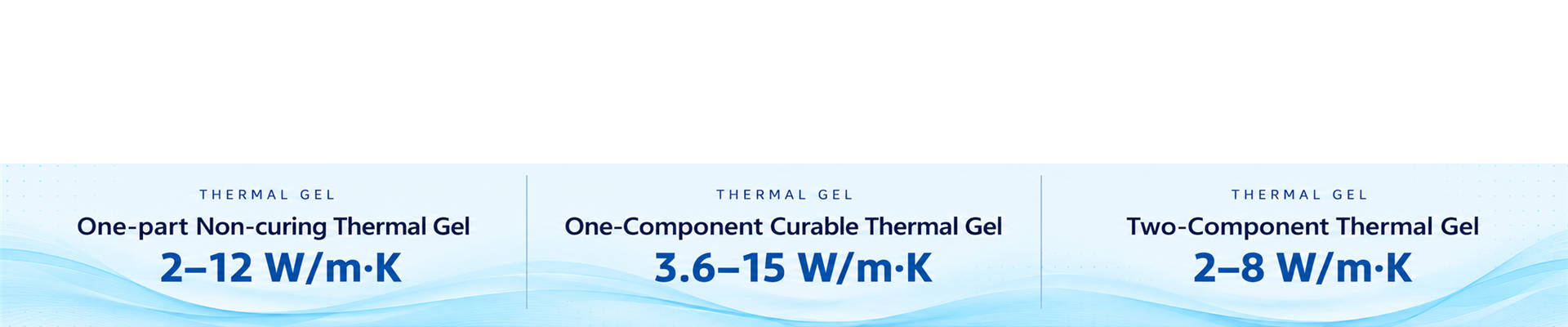
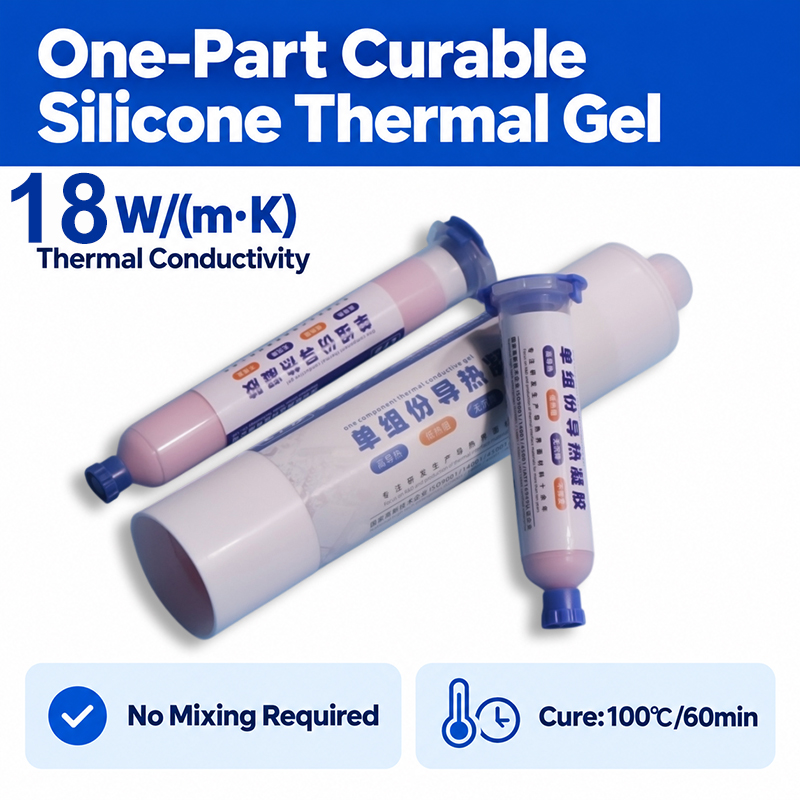
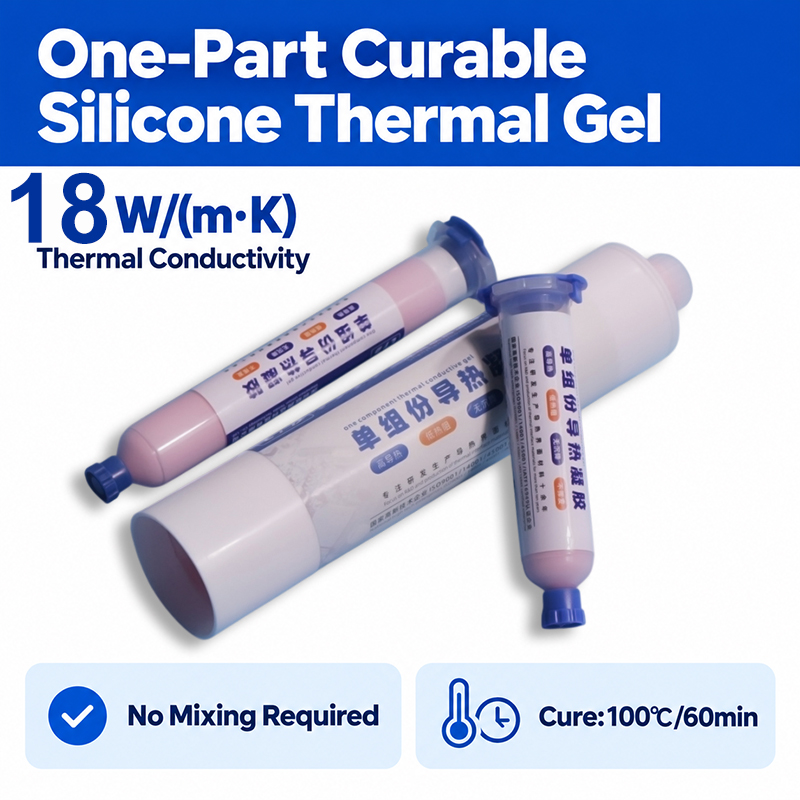
LCE1800T is a one-part, heat-curable thermally conductive silicone gel designed for electronic assemblies with demanding heat dissipation requirements. With a thermal conductivity of 18.0 ± 0.5 W/m·K, it creates a conductive thermal interface between heat-generating components and heat sinks, cooling plates, or module housings.
Its dispensable formulation allows material to be applied directly to the required interface, filling gaps and conforming to uneven mating surfaces during assembly. This helps improve the effective contact area and reduce thermal contact resistance caused by air voids.
After curing at 100°C for 60 minutes, LCE1800T forms a compliant silicone elastomer with a hardness of 70 ± 10 Shore OO. The cured material provides a pad-like thermal interface shaped to the assembly geometry, accommodating surface irregularities and component height variations.
The one-part system requires no two-component proportioning or mixing and supports automated dispensing with suitable equipment and process settings.
LCE1800T 18 W/m·K One-Part Thermally Conductive Silicone Gel
High-Conductivity Thermal Gap Filler for Electronic Cooling
|
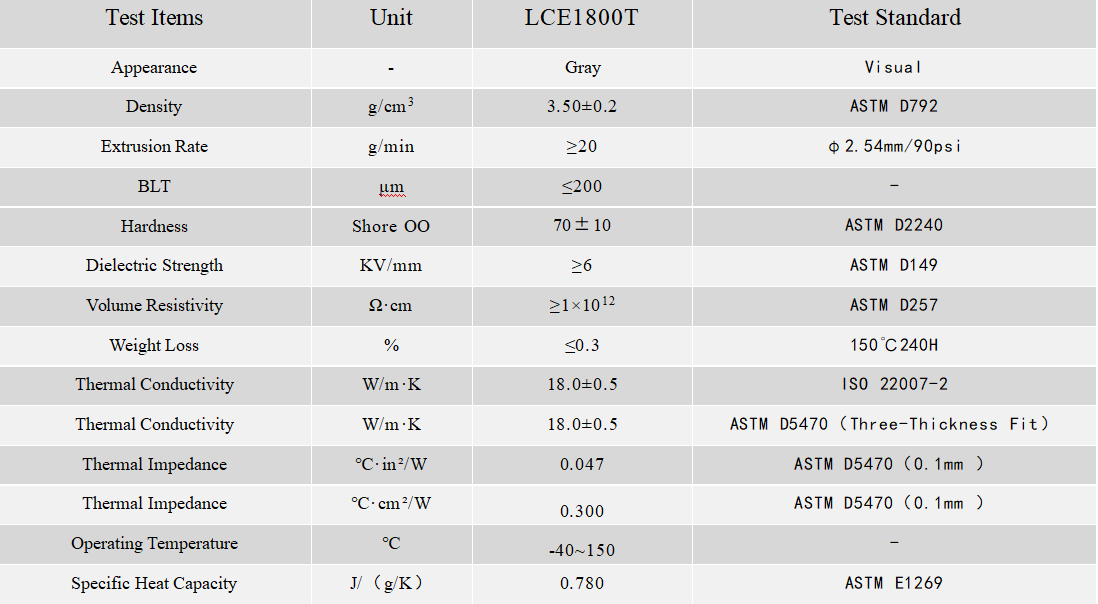
Test Items |
Unit |
LCE1800T |
Test Standard |
|
Appearance |
- |
Gray |
Visual |
|
Density |
g/cm3 |
3.50±0.2 |
ASTM D792 |
|
Extrusion Rate |
g/min |
≥20 |
φ2.54mm/90psi |
|
BLT |
μm |
≤200 |
- |
|
Hardness |
Shore OO |
70±10 |
ASTM D2240 |
|
Dielectric Strength |
KV/mm |
≥6 |
ASTM D149 |
|
Volume Resistivity |
Ω·cm |
≥1×10¹² |
ASTM D257 |
|
Weight Loss |
% |
≤0.3 |
150℃240H |
|
Thermal Conductivity |
W/m·K |
18.0±0.5 |
ISO 22007-2 |
|
Thermal Conductivity |
W/m·K |
18.0±0.5 |
ASTM D5470(Three-Thickness Fit) |
|
Thermal Impedance |
℃·in²/W |
0.047 |
ASTM D5470(0.1mm ) |
|
Thermal Impedance |
℃·cm²/W |
0.300 |
ASTM D5470(0.1mm ) |
|
Operating Temperature |
℃ |
-40~150 |
- |
|
Specific Heat Capacity |
J/(g/K) |
0.780 |
ASTM E1269 |
Provides an efficient heat transfer path between electronic components and cooling structures for applications requiring high thermal conductivity.
Fills interface gaps and follows mating surface profiles, helping minimize insulating air pockets and improve thermal coupling.
Combines the placement flexibility of a dispensable thermal gap filler with an elastomeric structure formed through heat curing.
Eliminates two-component ratio control and mixing, simplifying preparation for manual or automated dispensing.
Designed for thermal interfaces requiring low assembly pressure. Material quantity, gap dimensions, and assembly conditions should be selected to meet component loading requirements.
Accommodates variations in component height and mating surface geometry, supporting thermal contact across uneven interfaces.
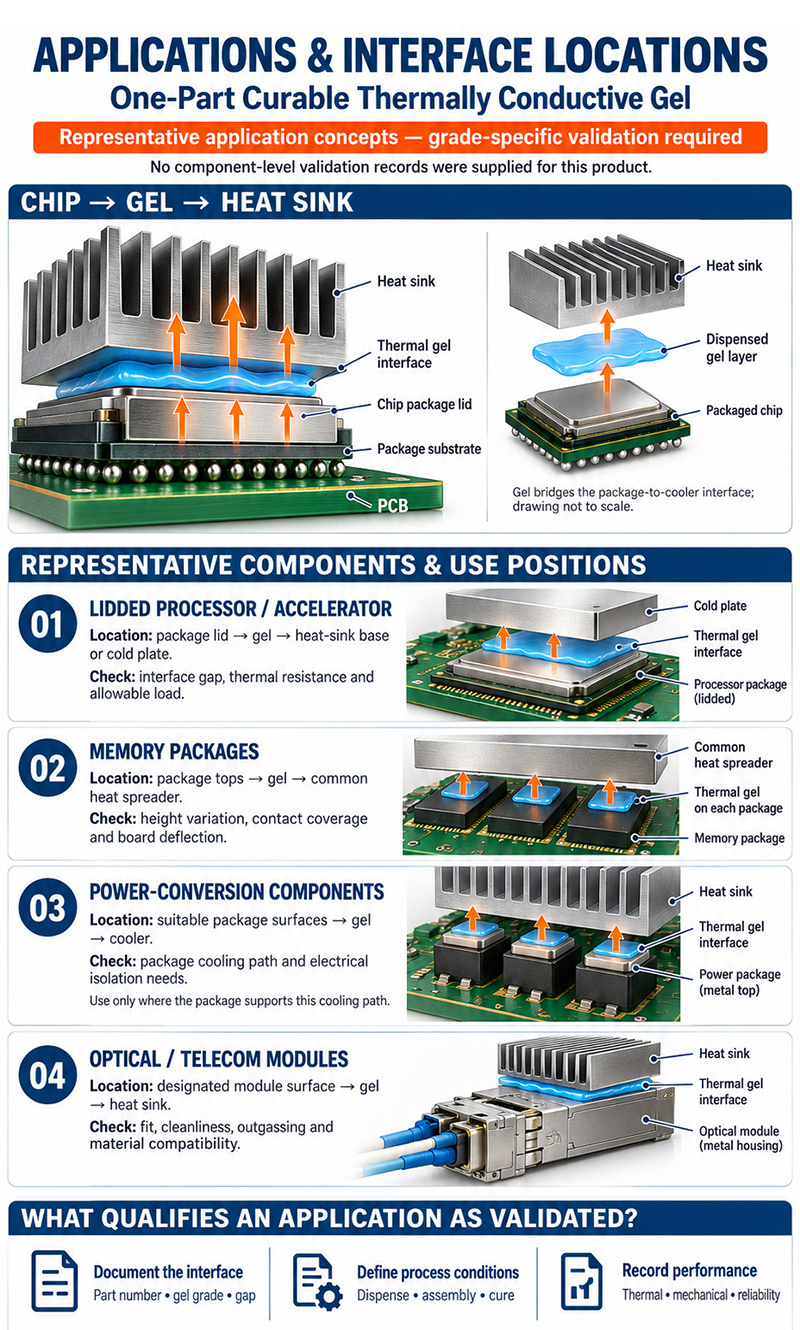
Application Areas
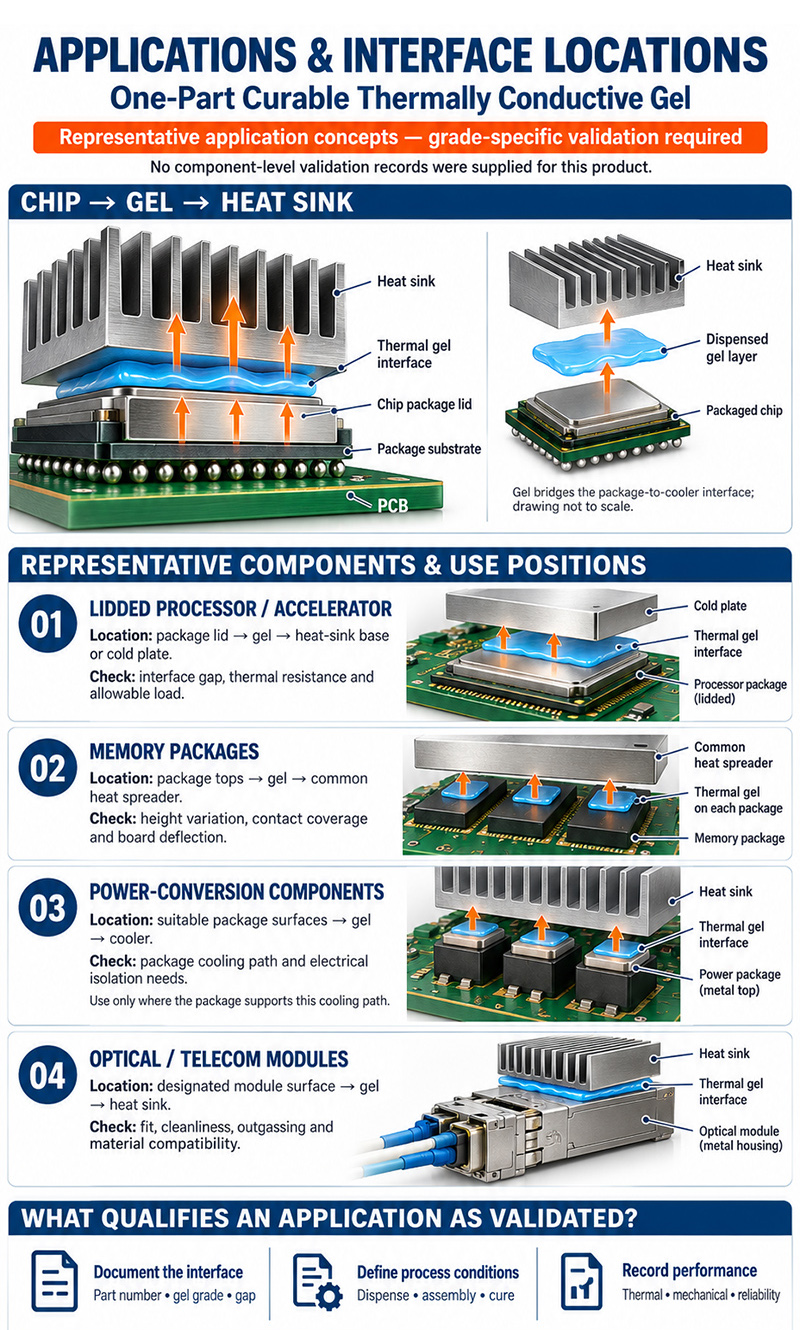
Power conversion and amplification: Gap filling between power modules, power semiconductors, power amplifiers, and heat dissipation structures.
Telecommunications infrastructure: Thermal management for base stations, 5G equipment, and networking electronics.
Automotive electronic modules: Heat transfer from battery management systems (BMS), vehicle control modules, and other heat-generating components to cooling structures.

|
Test Items |
Unit |
LCE1800T |
Test Standard |
|
Appearance |
- |
Gray |
Visual |
|
Density |
g/cm3 |
3.50±0.2 |
ASTM D792 |
|
Extrusion Rate |
g/min |
≥20 |
φ2.54mm/90psi |
|
BLT |
μm |
≤200 |
- |
|
Hardness |
Shore OO |
70±10 |
ASTM D2240 |
|
Dielectric Strength |
KV/mm |
≥6 |
ASTM D149 |
|
Volume Resistivity |
Ω·cm |
≥1×10¹² |
ASTM D257 |
|
Weight Loss |
% |
≤0.3 |
150℃240H |
|
Thermal Conductivity |
W/m·K |
18.0±0.5 |
ISO 22007-2 |
|
Thermal Conductivity |
W/m·K |
18.0±0.5 |
ASTM D5470(Three-Thickness Fit) |
|
Thermal Impedance |
℃·in²/W |
0.047 |
ASTM D5470(0.1mm ) |
|
Thermal Impedance |
℃·cm²/W |
0.300 |
ASTM D5470(0.1mm ) |
|
Operating Temperature |
℃ |
-40~150 |
- |
|
Specific Heat Capacity |
J/(g/K) |
0.780 |
ASTM E1269 |
Power conversion and amplification: Gap filling between power modules, power semiconductors, power amplifiers, and heat dissipation structures.
Telecommunications infrastructure: Thermal management for base stations, 5G equipment, and networking electronics.
Automotive electronic modules: Heat transfer from battery management systems (BMS), vehicle control modules, and other heat-generating components to cooling structures.
Provides an efficient heat transfer path between electronic components and cooling structures for applications requiring high thermal conductivity.
Fills interface gaps and follows mating surface profiles, helping minimize insulating air pockets and improve thermal coupling.
Combines the placement flexibility of a dispensable thermal gap filler with an elastomeric structure formed through heat curing.
Eliminates two-component ratio control and mixing, simplifying preparation for manual or automated dispensing.
Designed for thermal interfaces requiring low assembly pressure. Material quantity, gap dimensions, and assembly conditions should be selected to meet component loading requirements.
Accommodates variations in component height and mating surface geometry, supporting thermal contact across uneven interfaces.

Tel:+86-13691979380
+86-19065180554
E-mail:elvinlen@szutd.com
Carly@szutd.com
Address:8th Floor, Tower B, Lechuanghui Building, No. 1211 Guanguang Road, Longhua District, Shenzhen City, Guangdong Province


 Send Request
 Whatsapp