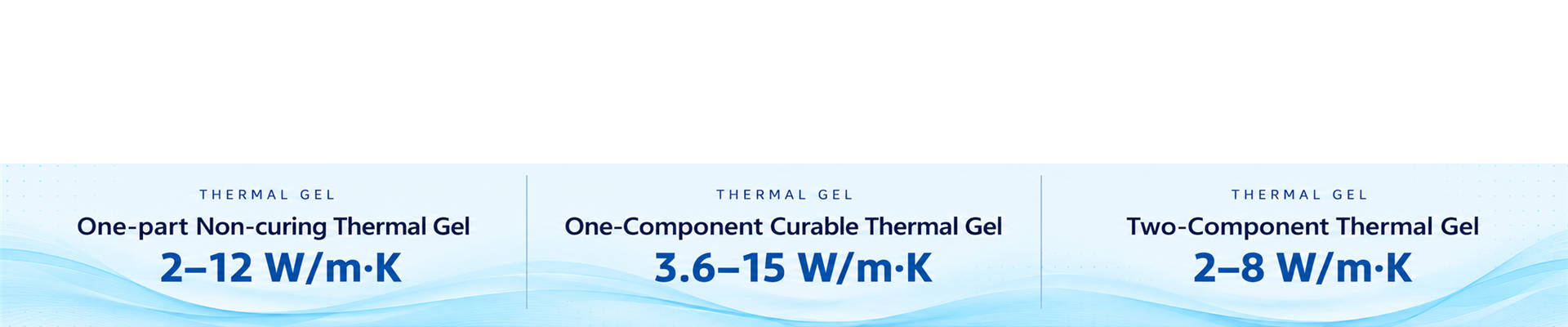
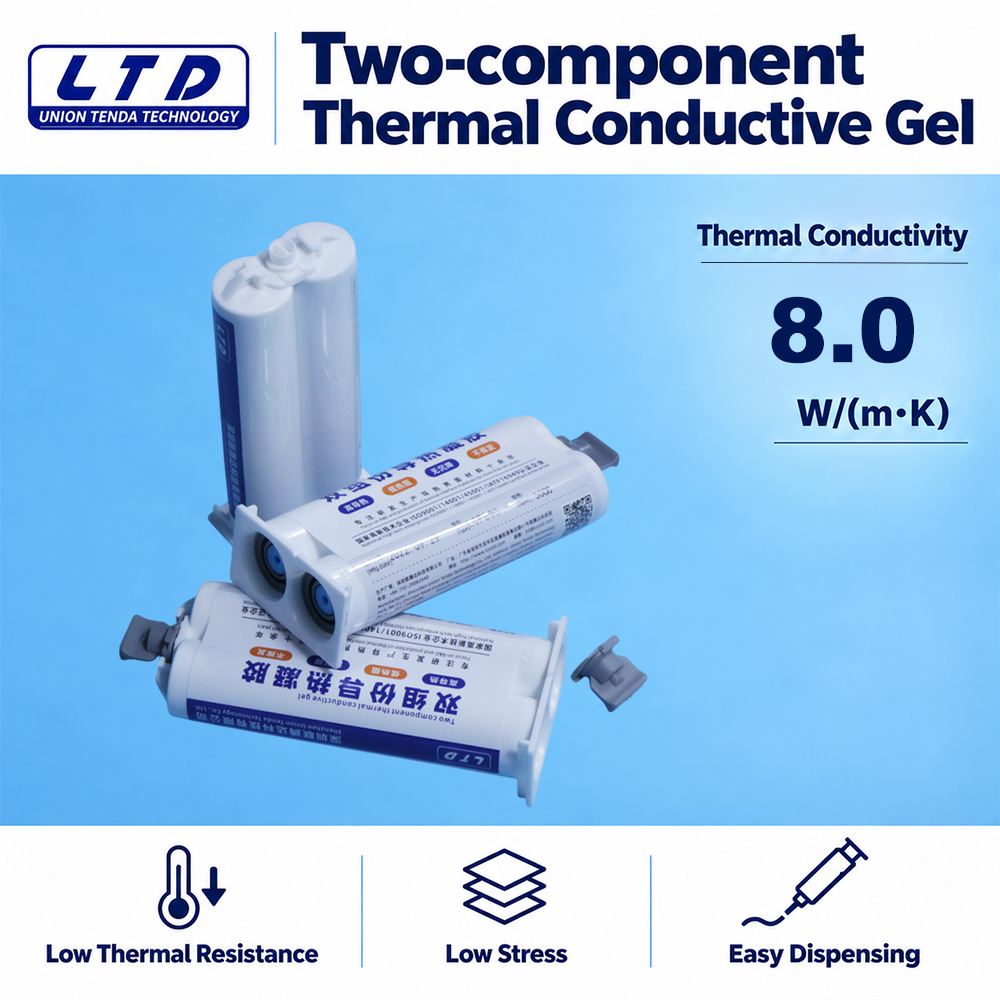
LCF800 is a two-component thermally conductive gel designed to fill gaps between electronic components and heat dissipation structures. With a thermal conductivity of 8.0 ± 0.3 W/m·K, it provides a conductive heat transfer path for electronic assemblies requiring efficient thermal management.
The material cures at room temperature or elevated temperatures to form a soft, thermally conductive elastomer. Before curing, it conforms to irregular mating surfaces and accommodates variations in gap thickness, helping improve surface contact and reduce thermal contact resistance. Once cured, it forms a compliant thermal interface similar to a thermal silicone pad.
Designed for automated metering, mixing, and dispensing, LCF800 supports controlled material placement across different component layouts and assembly geometries.
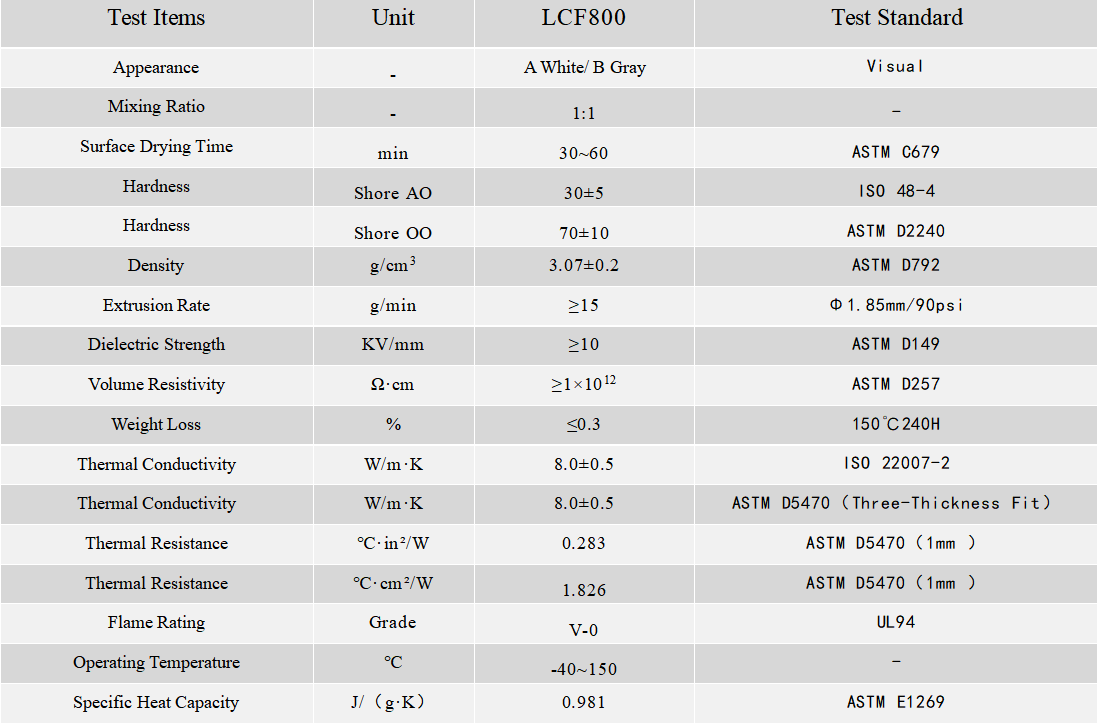
Test Items
Unit
LCF800
Test Standard
Appearance
-
A White/ B Gray
Visual
Mixing Ratio
-
1:1
-
Surface Drying Time
min
30~60
ASTM C679
Hardness
Shore AO
30±5
ISO 48-4
Hardness
Shore OO
70±10
ASTM D2240
Density
g/cm3
3.07±0.2
ASTM D792
Extrusion Rate
g/min
≥15
Φ1.85mm/90psi
Dielectric Strength
KV/mm
≥10
ASTM D149
Volume Resistivity
Ω·cm
≥1×10¹²
ASTM D257
Weight Loss
%
≤0.3
150℃240H
Thermal Conductivity
W/m·K
8.0±0.5
ISO 22007-2
Thermal Conductivity
W/m·K
8.0±0.5
ASTM D5470(Three-Thickness Fit)
Thermal Resistance
℃·in²/W
0.283
ASTM D5470(1mm )
Thermal Resistance
℃·cm²/W
1.826
ASTM D5470(1mm )
Flame Rating
Grade
V-0
UL94
Operating Temperature
℃
-40~150
-
Specific Heat Capacity
J/(g·K)
0.981
ASTM E1269
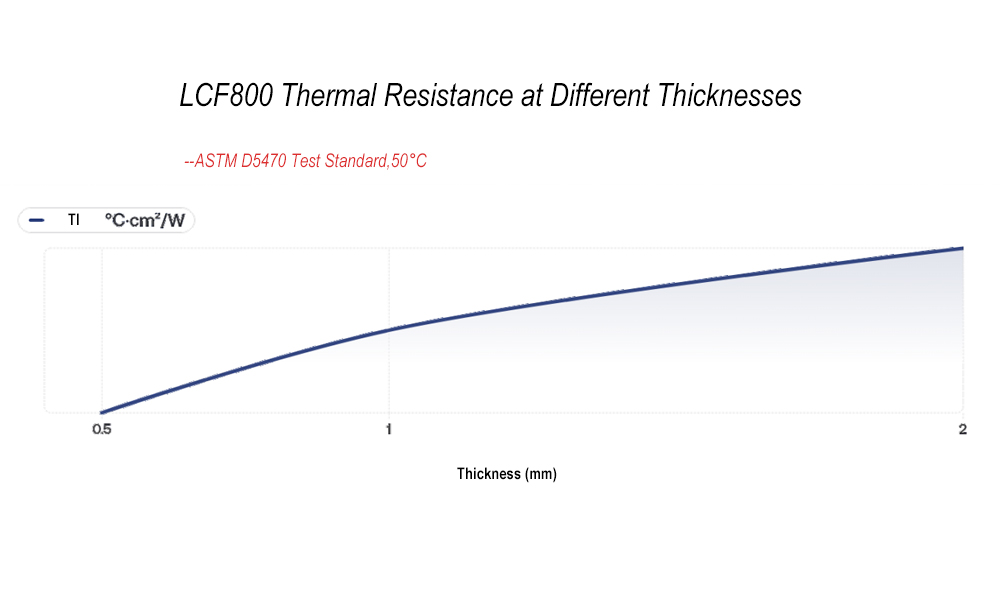
A thermal conductivity of 8.0 ± 0.3 W/m·K supports heat transfer from heat-generating components to heat sinks, cooling plates, and other thermal management structures.
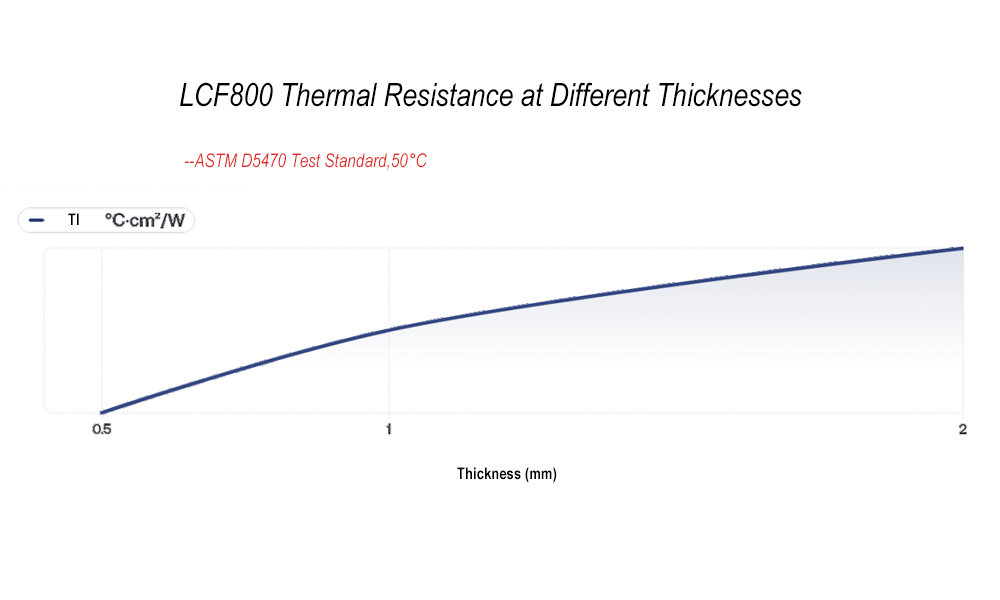
LCF800 conforms to mating surfaces to help minimize interfacial air gaps and improve thermal contact. Its reported thermal resistance is 0.283 °C·in²/W under the applicable test conditions.
The low oil bleed formulation helps limit oil migration around the thermal interface, supporting cleaner electronic assemblies.
The compliant material accommodates dimensional tolerances and helps reduce mechanical stress on sensitive components during assembly.
Its dispensable form allows the applied volume and pattern to be adjusted for uneven surfaces, complex geometries, and variations in component height.
Two-component dispensing enables controlled application and integration into automated assembly processes. Room-temperature and heat-accelerated curing options provide flexibility in production planning.
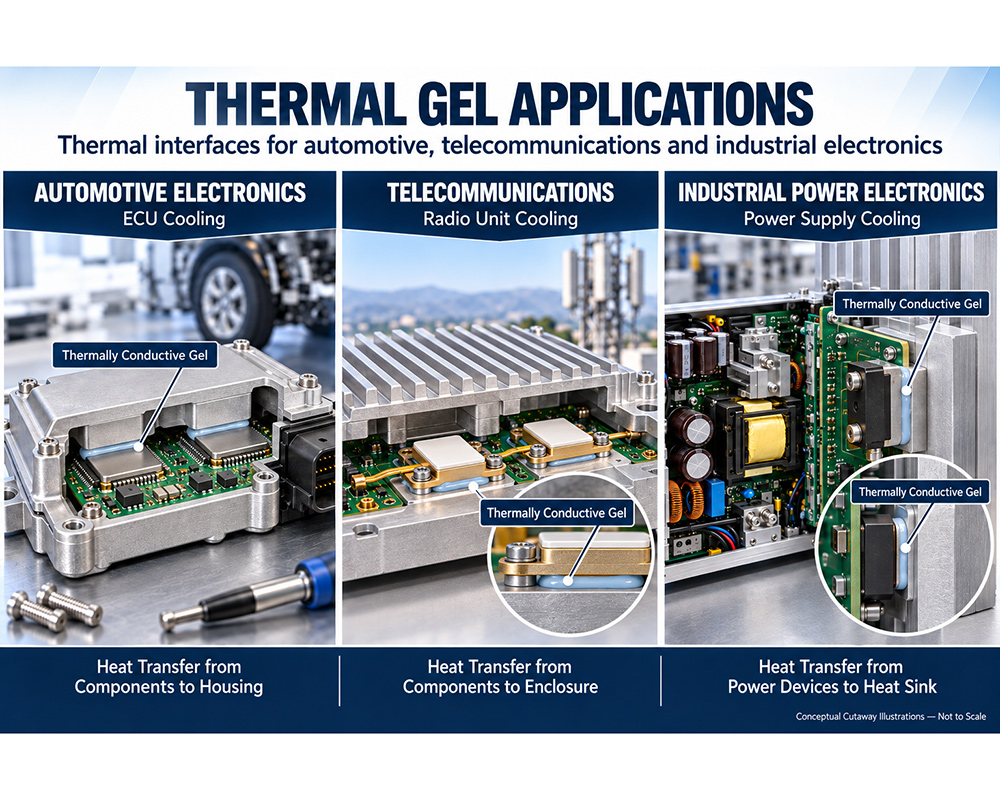
LCF800 is suitable for evaluation in electronic assemblies requiring high thermal conductivity, low oil bleed, and conformable gap filling, including:
Interfaces between electronic components and heat sinks or cooling plates
Power electronics and control modules
Thermal modules with uneven mating surfaces
Assemblies with varying component heights or gap dimensions
Production lines using automated thermal interface material dispensing
Contact us for the LCF800 technical data sheet and to discuss gap dimensions, dispensing requirements, curing conditions, and application suitability.

|
Test Items |
Unit |
LCF800 |
Test Standard |
|
Appearance |
- |
A White/ B Gray |
Visual |
|
Mixing Ratio |
- |
1:1 |
- |
|
Surface Drying Time |
min |
30~60 |
ASTM C679 |
|
Hardness |
Shore AO |
30±5 |
ISO 48-4 |
|
Hardness |
Shore OO |
70±10 |
ASTM D2240 |
|
Density |
g/cm3 |
3.07±0.2 |
ASTM D792 |
|
Extrusion Rate |
g/min |
≥15 |
Φ1.85mm/90psi |
|
Dielectric Strength |
KV/mm |
≥10 |
ASTM D149 |
|
Volume Resistivity |
Ω·cm |
≥1×10¹² |
ASTM D257 |
|
Weight Loss |
% |
≤0.3 |
150℃240H |
|
Thermal Conductivity |
W/m·K |
8.0±0.5 |
ISO 22007-2 |
|
Thermal Conductivity |
W/m·K |
8.0±0.5 |
ASTM D5470(Three-Thickness Fit) |
|
Thermal Resistance |
℃·in²/W |
0.283 |
ASTM D5470(1mm ) |
|
Thermal Resistance |
℃·cm²/W |
1.826 |
ASTM D5470(1mm ) |
|
Flame Rating |
Grade |
V-0 |
UL94 |
|
Operating Temperature |
℃ |
-40~150 |
- |
|
Specific Heat Capacity |
J/(g·K) |
0.981 |
ASTM E1269 |
A thermal conductivity of 8.0 ± 0.3 W/m·K supports heat transfer from heat-generating components to heat sinks, cooling plates, and other thermal management structures.
LCF800 conforms to mating surfaces to help minimize interfacial air gaps and improve thermal contact. Its reported thermal resistance is 0.283 °C·in²/W under the applicable test conditions.
The low oil bleed formulation helps limit oil migration around the thermal interface, supporting cleaner electronic assemblies.
The compliant material accommodates dimensional tolerances and helps reduce mechanical stress on sensitive components during assembly.
Its dispensable form allows the applied volume and pattern to be adjusted for uneven surfaces, complex geometries, and variations in component height.
Two-component dispensing enables controlled application and integration into automated assembly processes. Room-temperature and heat-accelerated curing options provide flexibility in production planning.

Tel:+86-13691979380
+86-18126358702
E-mail:elvinlen@szutd.com
kacey@szutd.com
Address:8th Floor, Tower B, Lechuanghui Building, No. 1211 Guanguang Road, Longhua District, Shenzhen City, Guangdong Province


 Send Request
 Whatsapp