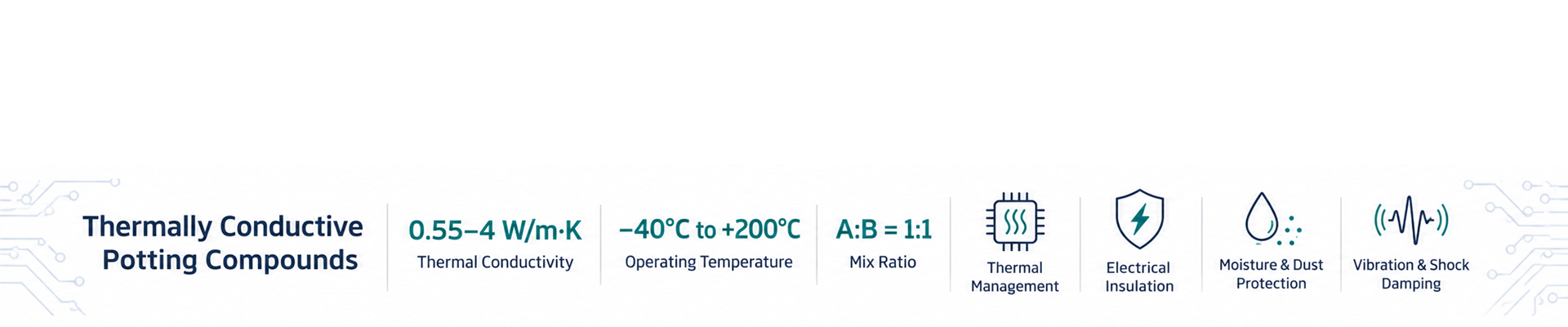
Thermally conductive bonding and sealing for electrically insulated assemblies.
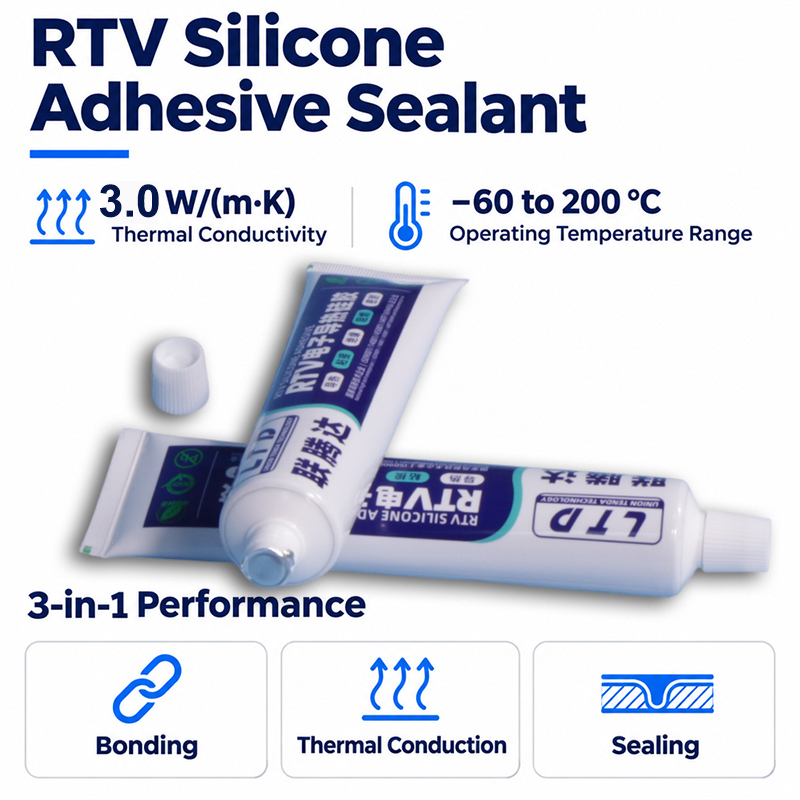
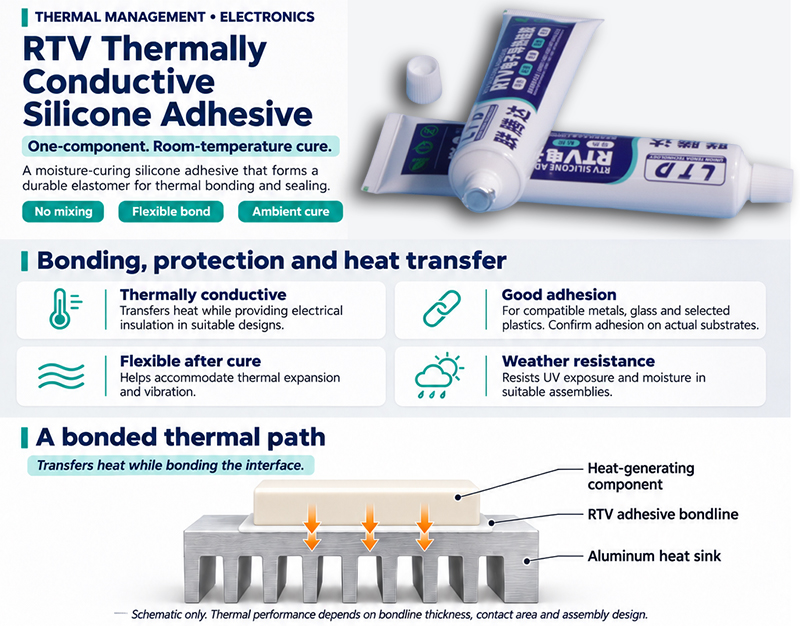
LCF1930 is a one-component RTV silicone adhesive designed for assemblies that require heat transfer, component attachment, and environmental sealing within the same joint. Its thermal conductivity of 3.0 ± 0.3 W/m·K supports conductive heat transfer between bonded surfaces, while a dielectric strength of at least 15 kV/mm provides electrical insulation.
The adhesive cures at room temperature to form a firm silicone elastomer with a hardness of 80 ± 10 Shore A and a tensile strength of ≥3.0 MPa. It combines this cured consistency with silicone elasticity to help accommodate stresses caused by thermal cycling, vibration, and mechanical shock.
LCF1930 is intended for bonding and sealing applications in electronics, automotive electronics, and industrial equipment. Weather resistance and a specified operating temperature range of −60°C to +200°C support use under varying environmental conditions.
|
|
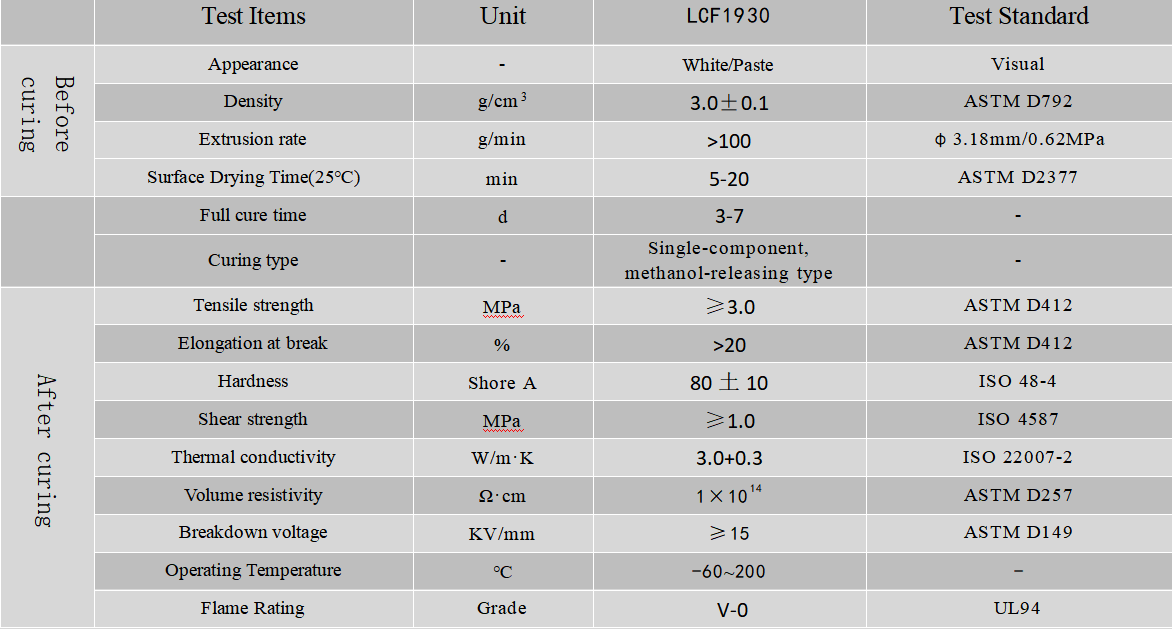
Test Items |
Unit |
LCF1930 |
Test Standard |
|
Before curing |
Appearance |
- |
White/Paste |
Visual |
|
|
Density |
g/cm3 |
3.0±0.1 |
ASTM D792 |
|
|
Extrusion rate |
g/min |
>100 |
φ3.18mm/0.62MPa |
|
|
Surface Drying Time(25℃) |
min |
5-20 |
ASTM D2377 |
|
|
Full cure time |
d |
3-7 |
- |
|
|
Curing type |
- |
Single-component, methanol-releasing type |
- |
|
After curing |
Tensile strength |
MPa |
≥3.0 |
ASTM D412 |
|
|
Elongation at break |
% |
>20 |
ASTM D412 |
|
|
Hardness |
Shore A |
80土10 |
ISO 48-4 |
|
|
Shear strength |
MPa |
≥1.0 |
ISO 4587 |
|
|
Thermal conductivity |
W/m·K |
3.0+0.3 |
ISO 22007-2 |
|
|
Volume resistivity |
Ω·cm |
1×10¹⁴ |
ASTM D257 |
|
|
Breakdown voltage |
KV/mm |
≥15 |
ASTM D149 |
|
|
Operating Temperature |
℃ |
-60~200 |
- |
|
|
Flame Rating |
Grade |
V-0 |
UL94 |
LCF1930 provides a thermally conductive connection between joined parts. Its 3.0 ± 0.3 W/m·K thermal conductivity is relevant to assemblies where the adhesive layer forms part of the heat-transfer path.
The specified dielectric strength supports applications requiring an electrically insulating adhesive interface. Required insulation thickness and finished-assembly performance should be verified against the electrical design.
A hardness of 80 ± 10 Shore A makes cured consistency an important selection factor. Evaluate the material against the movement allowed at the joint and the mechanical sensitivity of the bonded components.
As a silicone adhesive sealant, LCF1930 bonds mating surfaces while helping seal interfaces against moisture exposure. Its weather resistance supports applications exposed to changing ambient conditions.
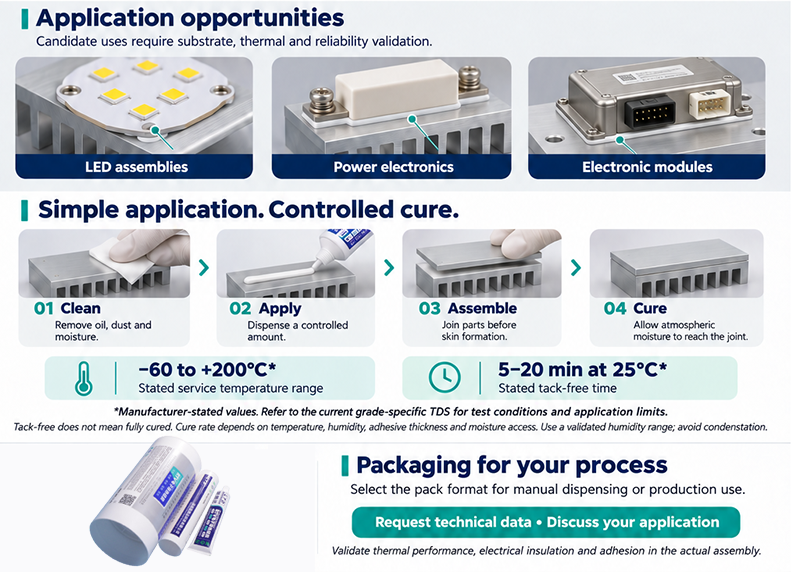
The formulation requires no component mixing and cures at room temperature, supporting straightforward dispensing and assembly.
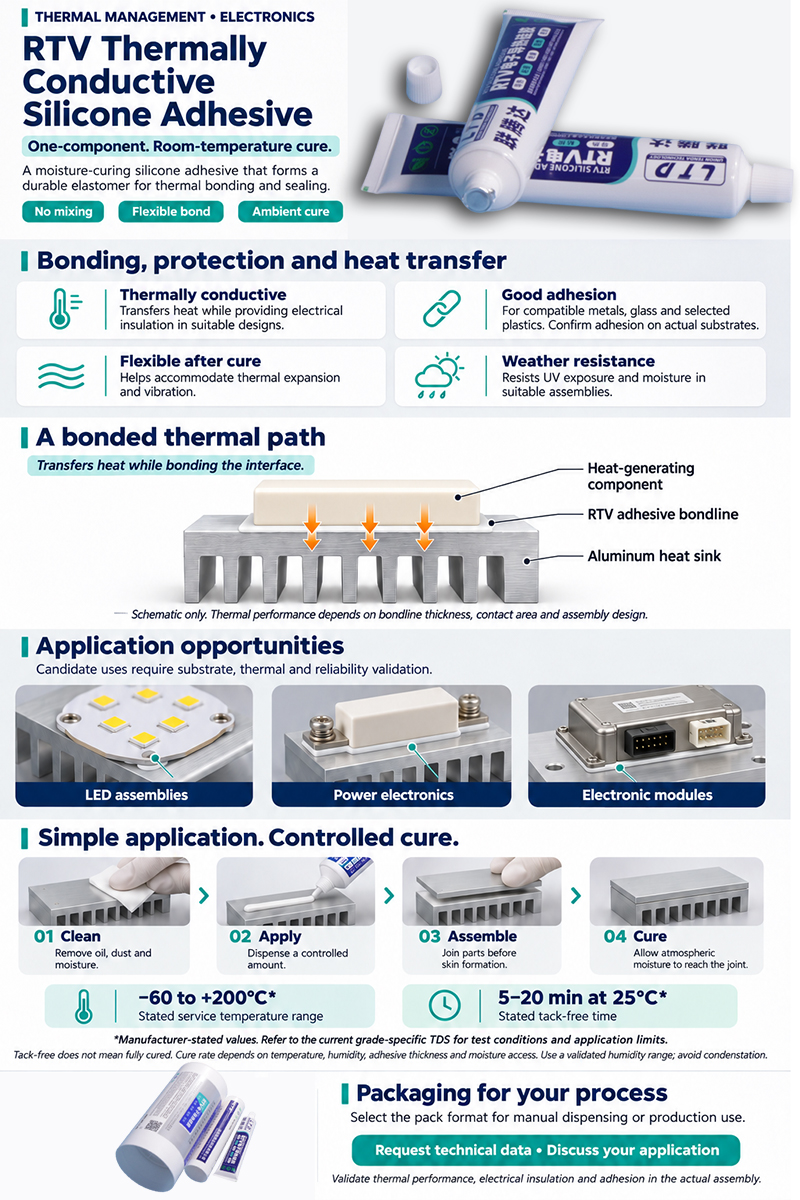
Electronic module integration: Bonding components that require electrical isolation together with mechanical fixing.
Automotive electronic assemblies: Bonding and sealing modules, sensor housings, and related interfaces, subject to application qualification.
Industrial electrical equipment: Sealing and securing parts exposed to vibration, mechanical shock, and temperature variation.
LCF1930 should be evaluated as part of the complete assembly. Thermal conductivity is one selection factor; bond-line thickness, bonded area, surface contact, and the surrounding thermal design also determine heat-transfer performance.
Mechanical suitability requires separate consideration. Shore A hardness describes resistance to indentation, while tensile strength describes the cured material’s resistance to tensile loading. Neither value alone establishes adhesion to a particular substrate.
Confirm substrate compatibility, surface preparation, and curing conditions through representative assembly trials. Consult the technical data sheet for processing details.
LCF1930 may be considered when a design requires a thermal glue with a specified conductivity of 3.0 W/m·K. Replacement suitability also depends on adhesion, cured hardness, bond-line geometry, and processing requirements. Validate the change in the actual assembly.
LCF1930 forms an elastomer but has a specified hardness of 80 ± 10 Shore A. For joints with substantial movement, assess cured flexibility and joint geometry rather than assuming that all silicone adhesives provide the same movement capability.
Key details include substrate materials, bonded area, adhesive thickness, heat-transfer requirements, electrical insulation requirements, expected joint movement, and operating conditions.
Reliable thermal performance starts with the right materials.
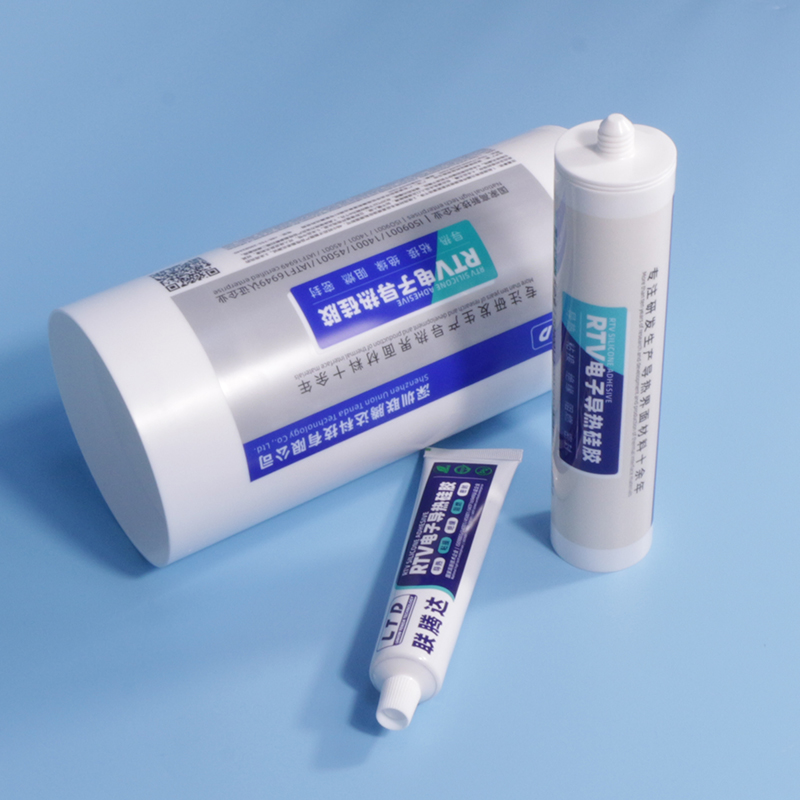
With 15 years of expertise, Union Tenda provides thermal interface materials tailored to your applications—from thermal pads and gels to greases, potting compounds and phase change materials. Our in-house R&D and testing capabilities, backed by a 20,000 m² production base, support customers across electronics, AI, EVs and energy storage.
Let's connect to discuss your thermal management needs.

|
|
Test Items |
Unit |
LCF1930 |
Test Standard |
|
Before curing |
Appearance |
- |
White/Paste |
Visual |
|
|
Density |
g/cm3 |
3.0±0.1 |
ASTM D792 |
|
|
Extrusion rate |
g/min |
>100 |
φ3.18mm/0.62MPa |
|
|
Surface Drying Time(25℃) |
min |
5-20 |
ASTM D2377 |
|
|
Full cure time |
d |
3-7 |
- |
|
|
Curing type |
- |
Single-component, methanol-releasing type |
- |
|
After curing |
Tensile strength |
MPa |
≥3.0 |
ASTM D412 |
|
|
Elongation at break |
% |
>20 |
ASTM D412 |
|
|
Hardness |
Shore A |
80土10 |
ISO 48-4 |
|
|
Shear strength |
MPa |
≥1.0 |
ISO 4587 |
|
|
Thermal conductivity |
W/m·K |
3.0+0.3 |
ISO 22007-2 |
|
|
Volume resistivity |
Ω·cm |
1×10¹⁴ |
ASTM D257 |
|
|
Breakdown voltage |
KV/mm |
≥15 |
ASTM D149 |
|
|
Operating Temperature |
℃ |
-60~200 |
- |
|
|
Flame Rating |
Grade |
V-0 |
UL94 |
Typical Applications
Features and Advantages

Tel:+86-13691979380
+86-19065180554
E-mail:elvinlen@szutd.com
Carly@szutd.com
Address:8th Floor, Tower B, Lechuanghui Building, No. 1211 Guanguang Road, Longhua District, Shenzhen City, Guangdong Province


 Send Request
 Whatsapp