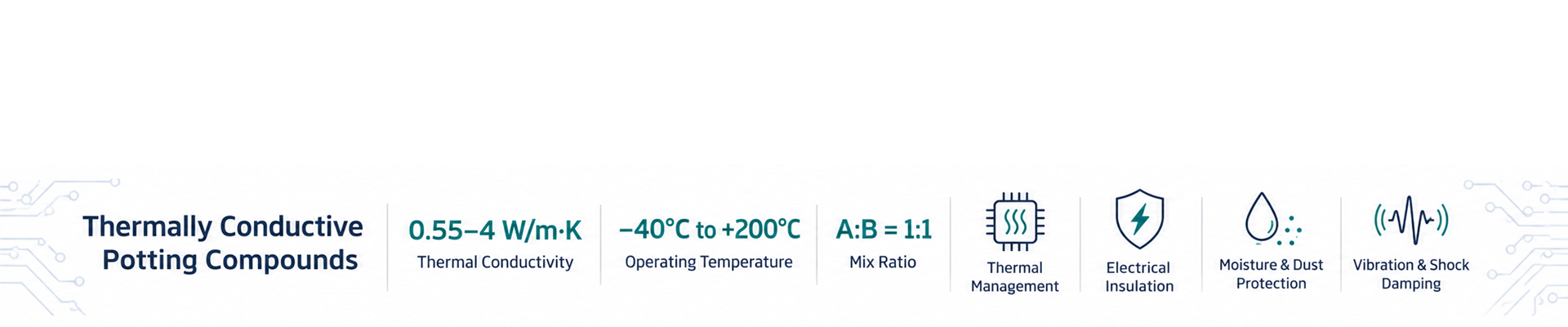
One-component thermally conductive adhesive for electrically insulating bonds and environmental sealing.
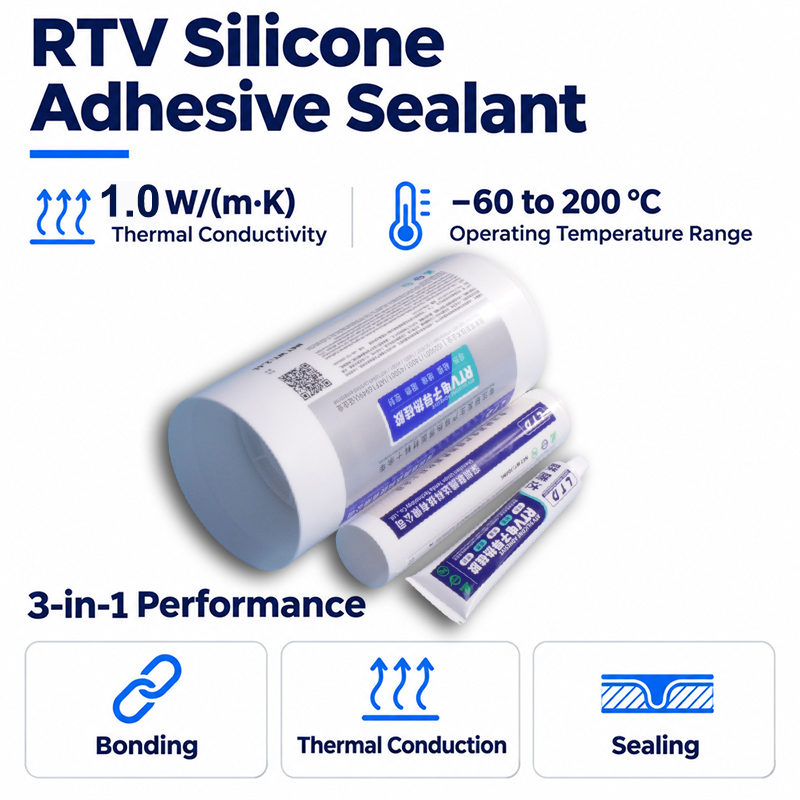
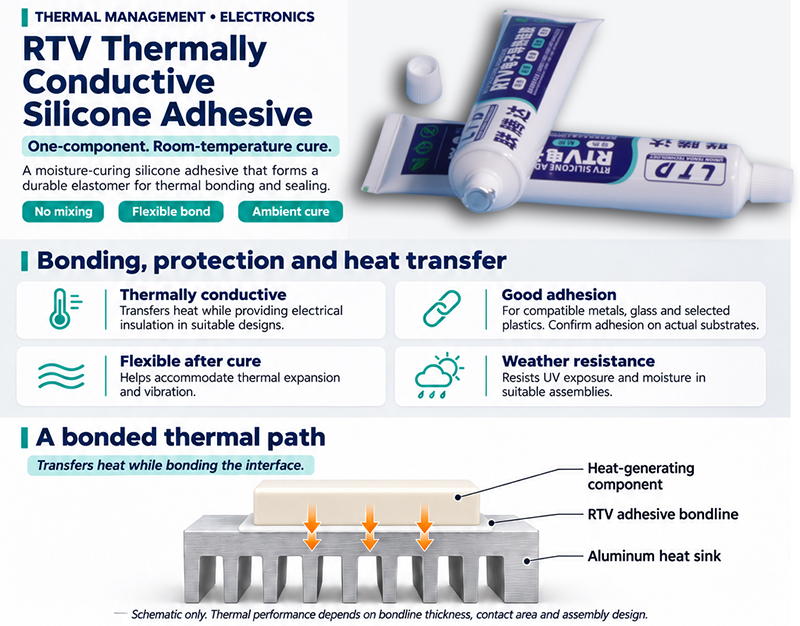
LCF1910 is a one-component, room-temperature-curing silicone adhesive sealant designed for electronic and industrial assemblies requiring bonding, heat transfer, and environmental protection. With a thermal conductivity of 1.0 ± 0.1 W/m·K, it provides a thermally conductive bond line while maintaining electrical insulation.
After curing, LCF1910 forms a durable silicone elastomer with a hardness of 70 ± 5 Shore A. The cured material combines a firm consistency with silicone elasticity, helping bonded joints accommodate stresses associated with thermal cycling, vibration, and mechanical shock.
Its weather resistance and operating temperature range of −60°C to +200°C support bonding and sealing applications exposed to changing environmental conditions.
|
|
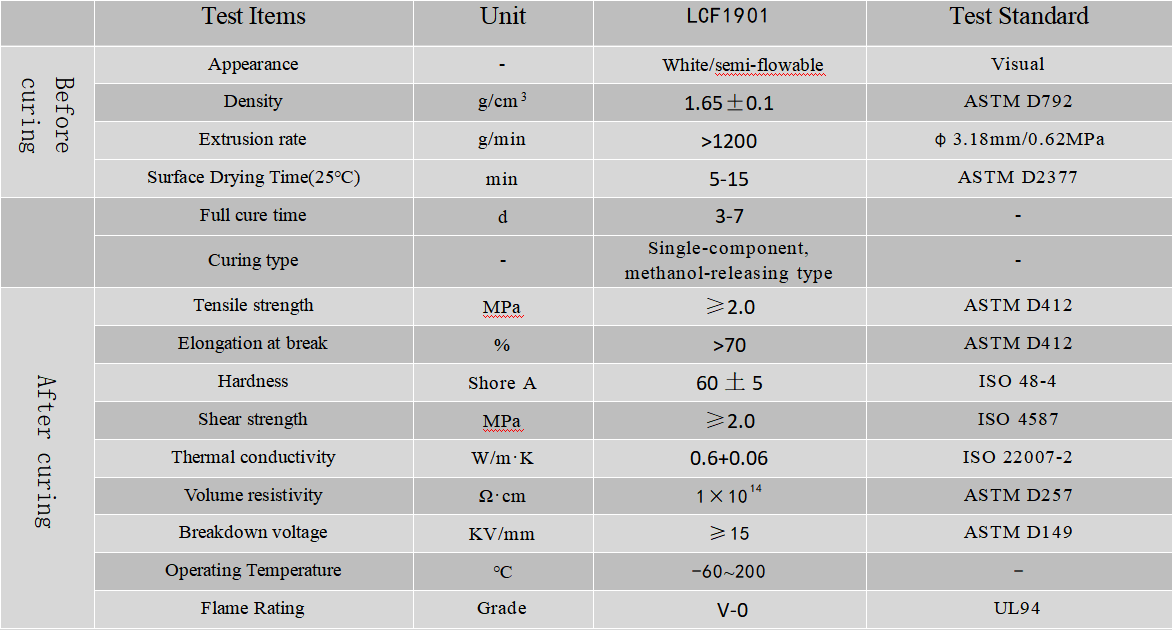
Test Items |
Unit |
LCF1910 |
Test Standard |
|
Before curing |
Appearance |
- |
White/Paste |
Visual |
|
|
Density |
g/cm3 |
1.80±0.1 |
ASTM D792 |
|
|
Extrusion rate |
g/min |
>500 |
φ3.18mm/0.62MPa |
|
|
Surface Drying Time(25℃) |
min |
5-20 |
ASTM D2377 |
|
|
Full cure time |
d |
3-7 |
- |
|
|
Curing type |
- |
Single-component, methanol-releasing type |
- |
|
After curing |
Tensile strength |
MPa |
≥2.0 |
ASTM D412 |
|
|
Elongation at break |
% |
>60 |
ASTM D412 |
|
|
Hardness |
Shore A |
70±5 |
ISO 48-4 |
|
|
Shear strength |
MPa |
≥2.0 |
ISO 4587 |
|
|
Thermal conductivity |
W/m·K |
1.0±0.1 |
ISO 22007-2 |
|
|
Volume resistivity |
Ω·cm |
1×10¹⁴ |
ASTM D257 |
|
|
Breakdown voltage |
KV/mm |
≥15 |
ASTM D149 |
|
|
Operating Temperature |
℃ |
-60~200 |
- |
|
|
Flame Rating |
Grade |
V-0 |
UL94 |
Resistance to mechanical stress: Retains elastomeric properties that help accommodate vibration, mechanical shock, and thermally induced movement.
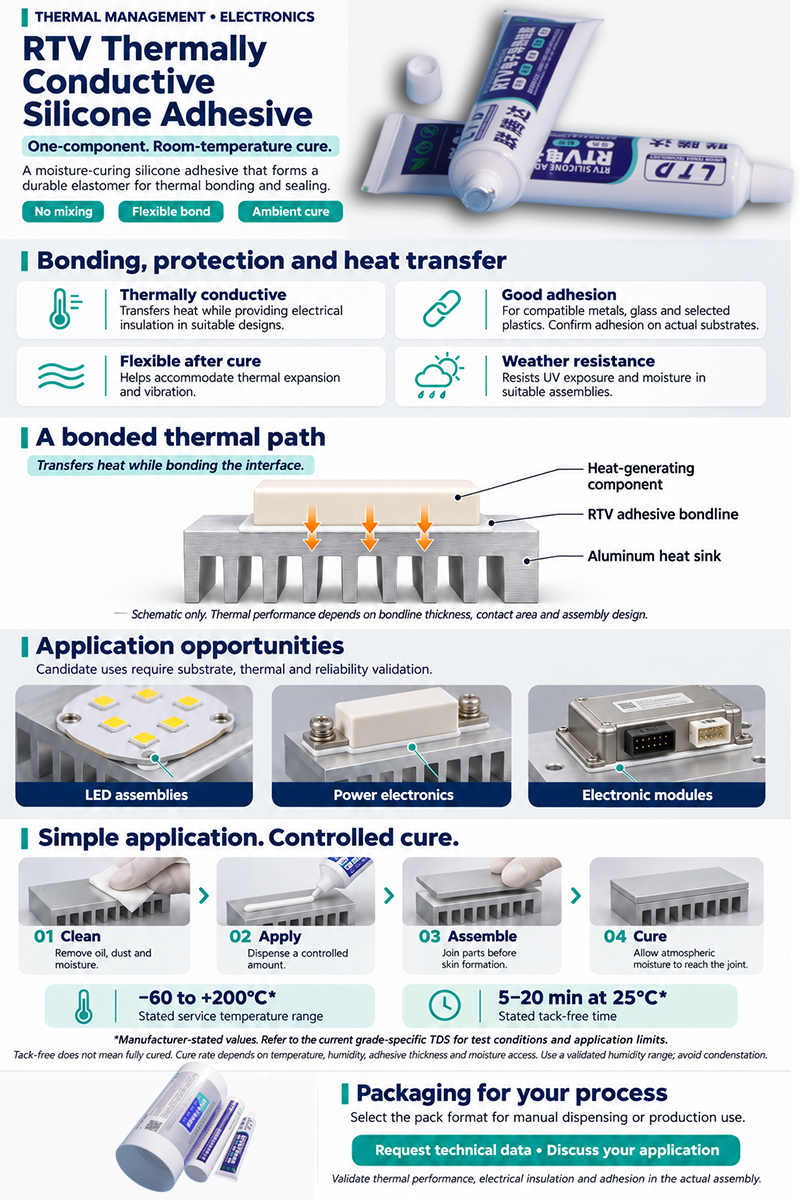
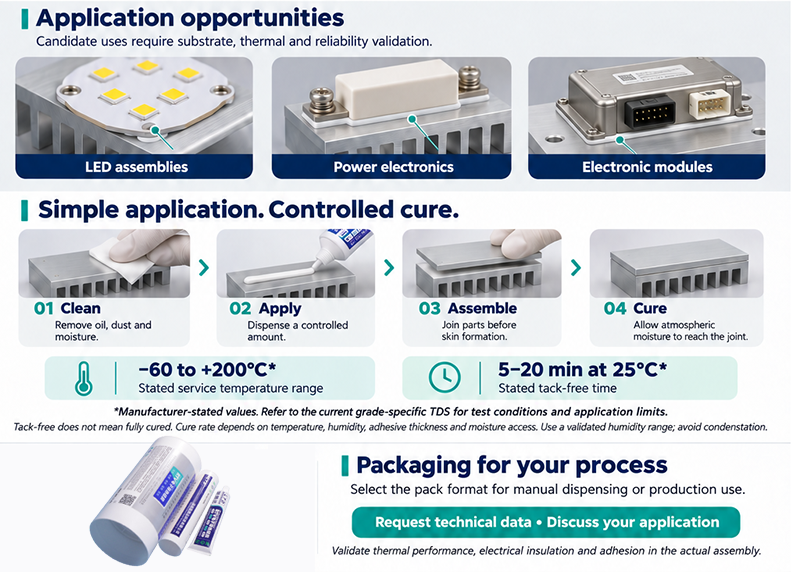
Bonding electronic components to supports or housings where heat transfer and electrical insulation are both design considerations.
Fixing and sealing electronic modules, sensor assemblies, and related housings exposed to temperature changes and vibration, subject to application-specific qualification.
Bonding and sealing enclosure joints and component interfaces where electrical insulation and environmental protection are required.
Securing components and sealing joints in equipment exposed to mechanical vibration and thermal cycling.
For thermally conductive adhesive applications, evaluate the complete joint rather than thermal conductivity alone. Bond-line thickness, contact area, surface condition, and interface quality all influence heat transfer.
Apply LCF1910 to clean, dry surfaces free from oil, dust, and other contaminants. Verify adhesion on the intended substrates and allow the adhesive to cure fully before service. Consult the technical data sheet for cure conditions, recommended application thickness, and handling guidance.
LCF1910 is a curing, thermally conductive silicone adhesive with a thermal conductivity of 1.0 ± 0.1 W/m·K. It can be considered for electronic assemblies requiring bonding, electrical insulation, and heat transfer. Suitability depends on the assembly’s heat load, joint geometry, and operating conditions.
Yes. LCF1910 functions as a silicone adhesive sealant, forming an elastomeric bond while sealing the joint interface. Final performance depends on substrate adhesion, joint design, and complete curing.
No. Shore A hardness measures the cured material’s resistance to indentation. LCF1910’s hardness of 70 ± 5 Shore A describes its cured consistency; adhesion must be evaluated separately on the actual substrates.
Reliable thermal performance starts with the right materials.
With 15 years of expertise, Union Tenda provides thermal interface materials tailored to your applications—from thermal pads and gels to greases, potting compounds and phase change materials. Our in-house R&D and testing capabilities, backed by a 20,000 m² production base, support customers across electronics, AI, EVs and energy storage.
Let's connect to discuss your thermal management needs.

|
|
Test Items |
Unit |
LCF1910 |
Test Standard |
|
Before curing |
Appearance |
- |
White/Paste |
Visual |
|
|
Density |
g/cm3 |
1.80±0.1 |
ASTM D792 |
|
|
Extrusion rate |
g/min |
>500 |
φ3.18mm/0.62MPa |
|
|
Surface Drying Time(25℃) |
min |
5-20 |
ASTM D2377 |
|
|
Full cure time |
d |
3-7 |
- |
|
|
Curing type |
- |
Single-component, methanol-releasing type |
- |
|
After curing |
Tensile strength |
MPa |
≥2.0 |
ASTM D412 |
|
|
Elongation at break |
% |
>60 |
ASTM D412 |
|
|
Hardness |
Shore A |
70±5 |
ISO 48-4 |
|
|
Shear strength |
MPa |
≥2.0 |
ISO 4587 |
|
|
Thermal conductivity |
W/m·K |
1.0±0.1 |
ISO 22007-2 |
|
|
Volume resistivity |
Ω·cm |
1×10¹⁴ |
ASTM D257 |
|
|
Breakdown voltage |
KV/mm |
≥15 |
ASTM D149 |
|
|
Operating Temperature |
℃ |
-60~200 |
- |
|
|
Flame Rating |
Grade |
V-0 |
UL94 |
Typical Applications
Features and Advantages

Tel:+86-13691979380
+86-19065180554
E-mail:elvinlen@szutd.com
Carly@szutd.com
Address:8th Floor, Tower B, Lechuanghui Building, No. 1211 Guanguang Road, Longhua District, Shenzhen City, Guangdong Province


 Send Request
 Whatsapp