
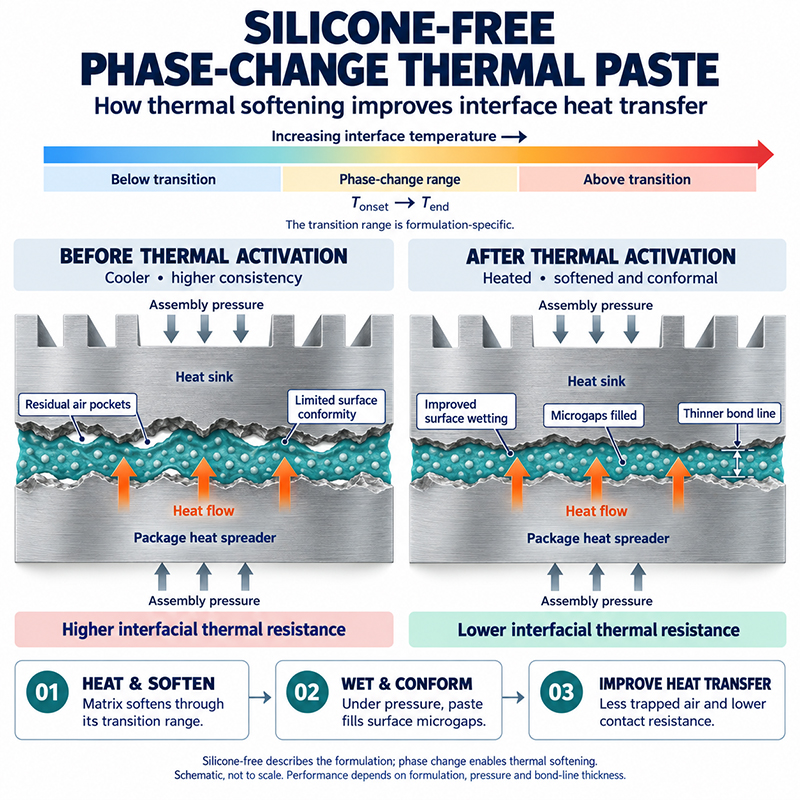
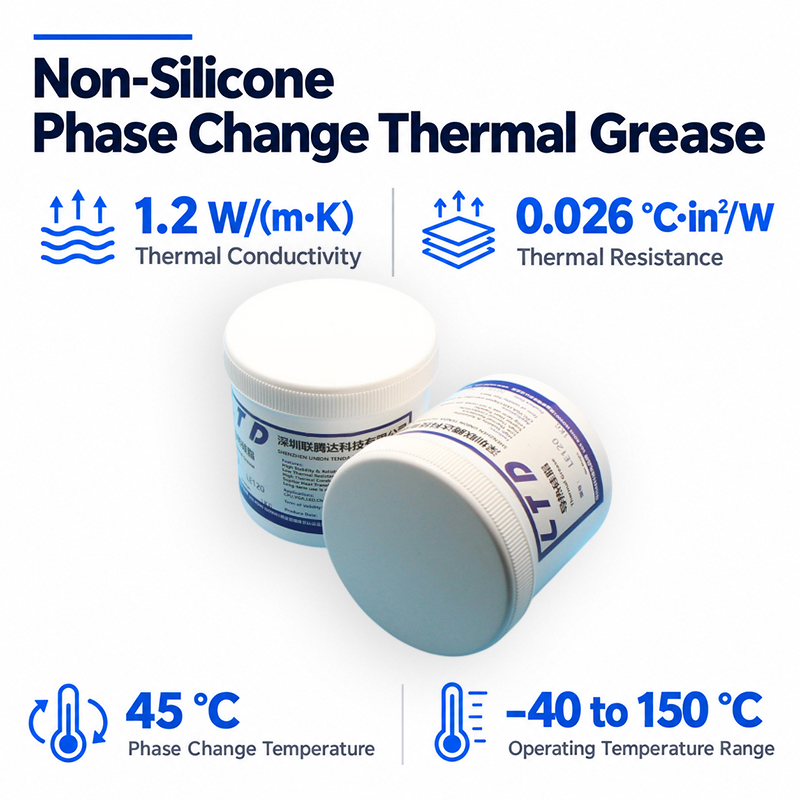
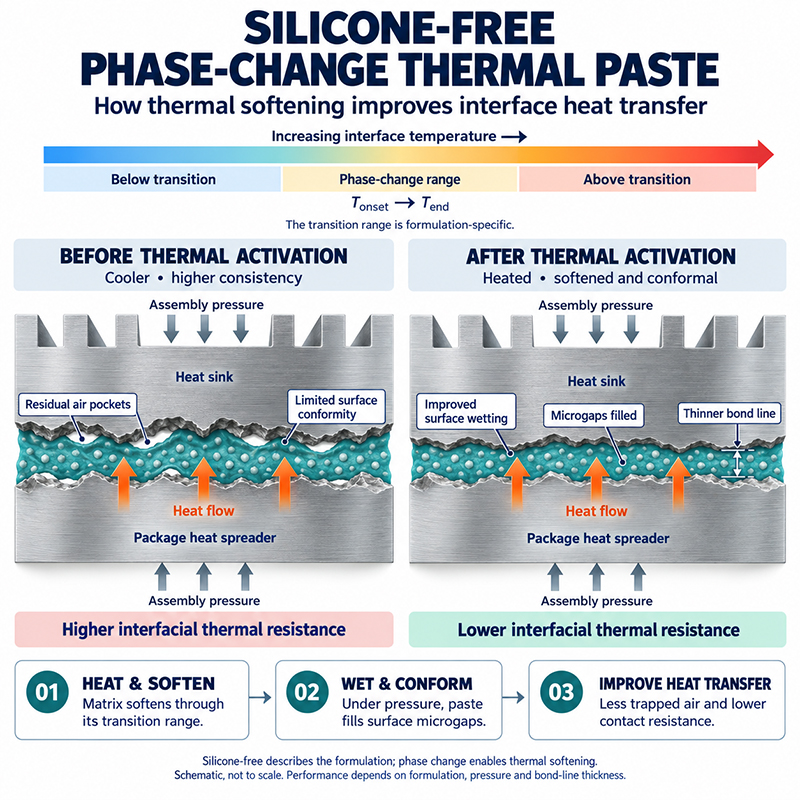
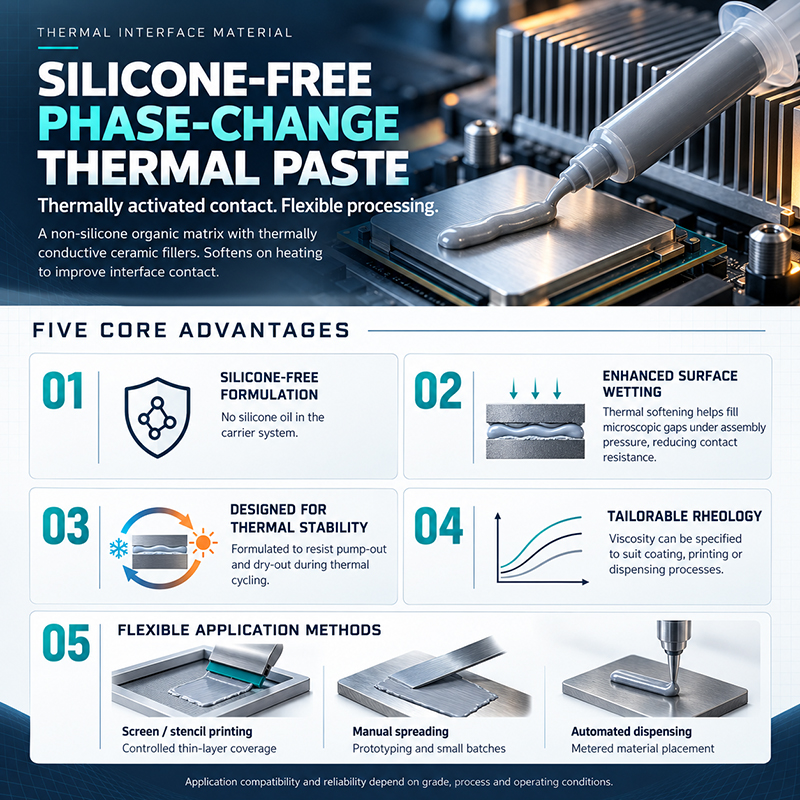
LEN120 is a non-silicone phase change thermal grease designed to improve heat transfer between electronic components and heat sinks. With a phase change temperature of ≥45°C, the material softens as it reaches its transition temperature, improving surface conformity and wetting to help reduce contact thermal resistance.
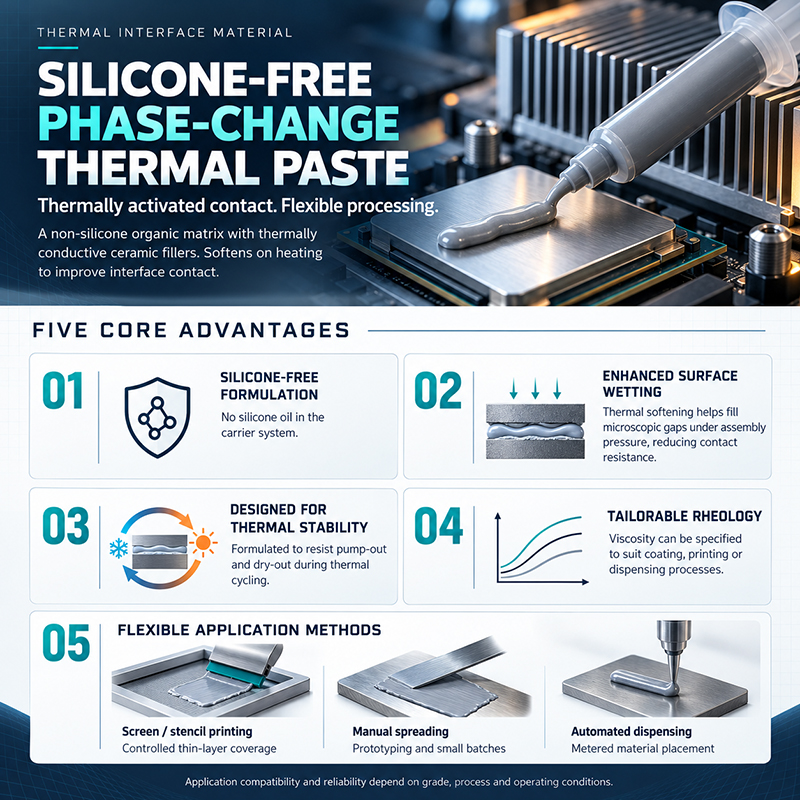
Its silicone-free formulation eliminates silicone oil leakage associated with silicone-based thermal compounds. Supporting a bond line thickness (BLT) of ≤10 μm, LEN120 provides a thin thermal interface for applications requiring close contact between mating surfaces.
This phase change thermal interface material (TIM) can be applied by screen printing, manual application, or automatic dispensing. Adjustable viscosity options support different application methods and production requirements.
|
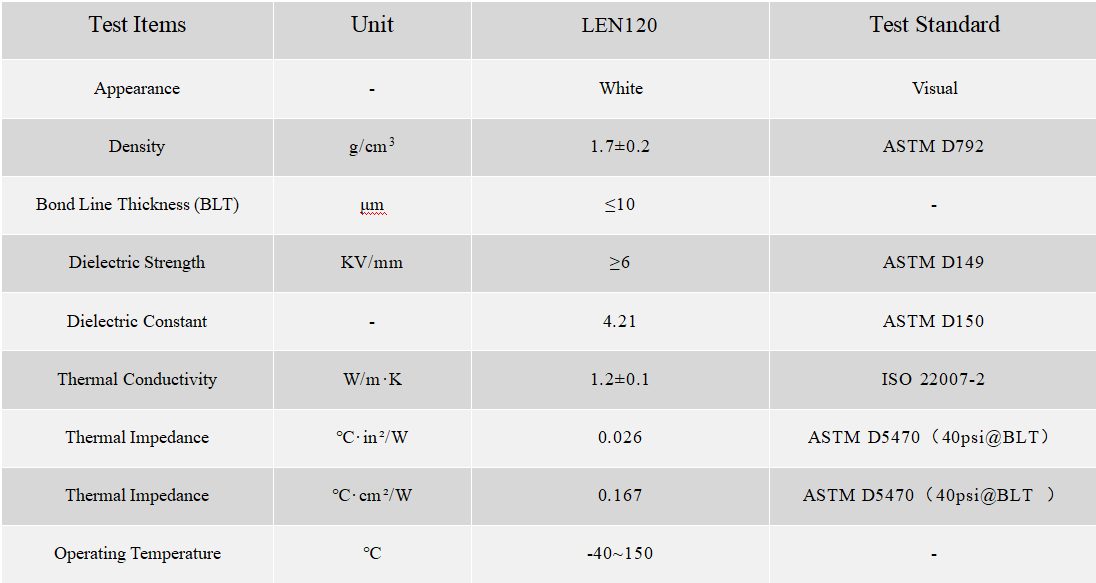
Test Items |
Unit |
LEN120 |
Test Standard |
|
Appearance |
- |
White |
Visual |
|
Density |
g/cm3 |
1.7±0.2 |
ASTM D792 |
|
Bond Line Thickness (BLT) |
μm |
≤10 |
- |
|
Dielectric Strength |
KV/mm |
≥6 |
ASTM D149 |
|
Dielectric Constant |
- |
4.21 |
ASTM D150 |
|
Thermal Conductivity |
W/m·K |
1.2±0.1 |
ISO 22007-2 |
|
Thermal Impedance |
℃·in²/W |
0.026 |
ASTM D5470(40psi@BLT) |
|
Thermal Impedance |
℃·cm²/W |
0.167 |
ASTM D5470(40psi@BLT ) |
|
Operating Temperature |
℃ |
-40~150 |
- |
Non-silicone formulation: Suitable for applications where silicone oil migration or contamination is a concern.
Phase change behavior: Improves conformity to mating surfaces and helps fill microscopic surface irregularities.
Low thermal impedance: Helps reduce resistance to heat flow across the thermal interface.
Thin bond line: Supports a BLT of ≤10 μm for closely fitted thermal assemblies.
Reliable stability: Designed to maintain consistent thermal contact in electronic applications.
Thermal interfaces between ICs, CPUs, GPUs, or LED assemblies and heat sinks, helping transfer heat from the component to the cooling assembly.
Thermal management for power modules and power semiconductors requiring effective heat transfer across closely fitted interfaces.
Thermal interface applications in battery management systems (BMS) and engine control units (ECUs).
Thermal management for heat-generating components in routers, base station equipment, and related communication systems.
LEN120 thermal paste supports both manual assembly and automated production. Choose screen printing for patterned application, manual application for flexible assembly workflows, or automatic dispensing for controlled material placement.
Contact us to discuss viscosity requirements, application methods, and LEN120 suitability for your thermal interface design.
|
Test Items |
Unit |
LEN120 |
Test Standard |
|
Appearance |
- |
White |
Visual |
|
Density |
g/cm3 |
1.7±0.2 |
ASTM D792 |
|
Bond Line Thickness (BLT) |
μm |
≤10 |
- |
|
Dielectric Strength |
KV/mm |
≥6 |
ASTM D149 |
|
Dielectric Constant |
- |
4.21 |
ASTM D150 |
|
Thermal Conductivity |
W/m·K |
1.2±0.1 |
ISO 22007-2 |
|
Thermal Impedance |
℃·in²/W |
0.026 |
ASTM D5470(40psi@BLT) |
|
Thermal Impedance |
℃·cm²/W |
0.167 |
ASTM D5470(40psi@BLT ) |
|
Operating Temperature |
℃ |
-40~150 |
- |
Typical Applications
Features and Advantages

Tel:+86-13691979380
+86-19065180554
E-mail:elvinlen@szutd.com
Carly@szutd.com
Address:8th Floor, Tower B, Lechuanghui Building, No. 1211 Guanguang Road, Longhua District, Shenzhen City, Guangdong Province


 Send Request
 Whatsapp