
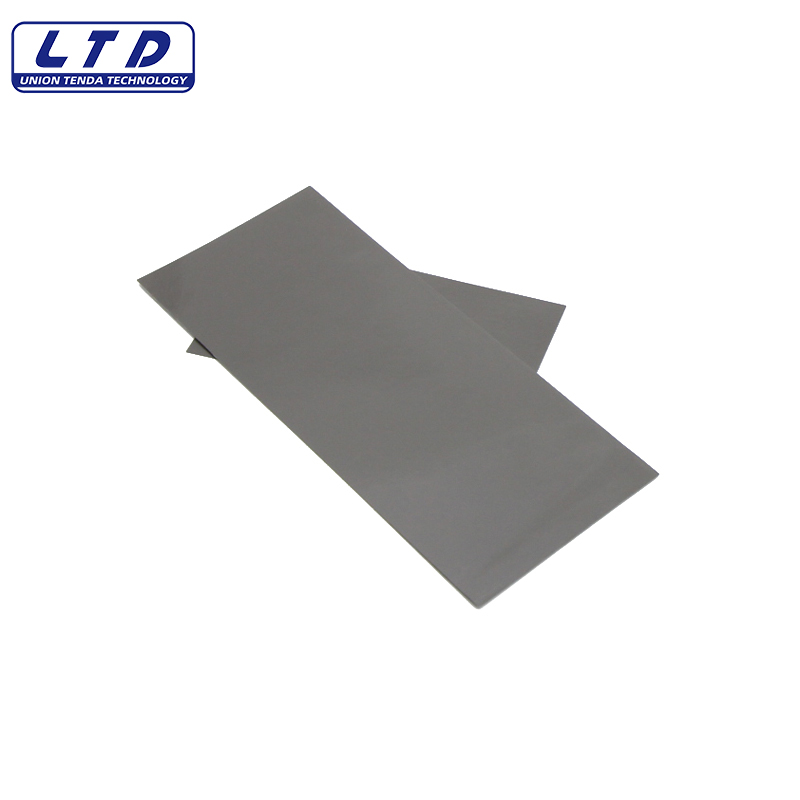
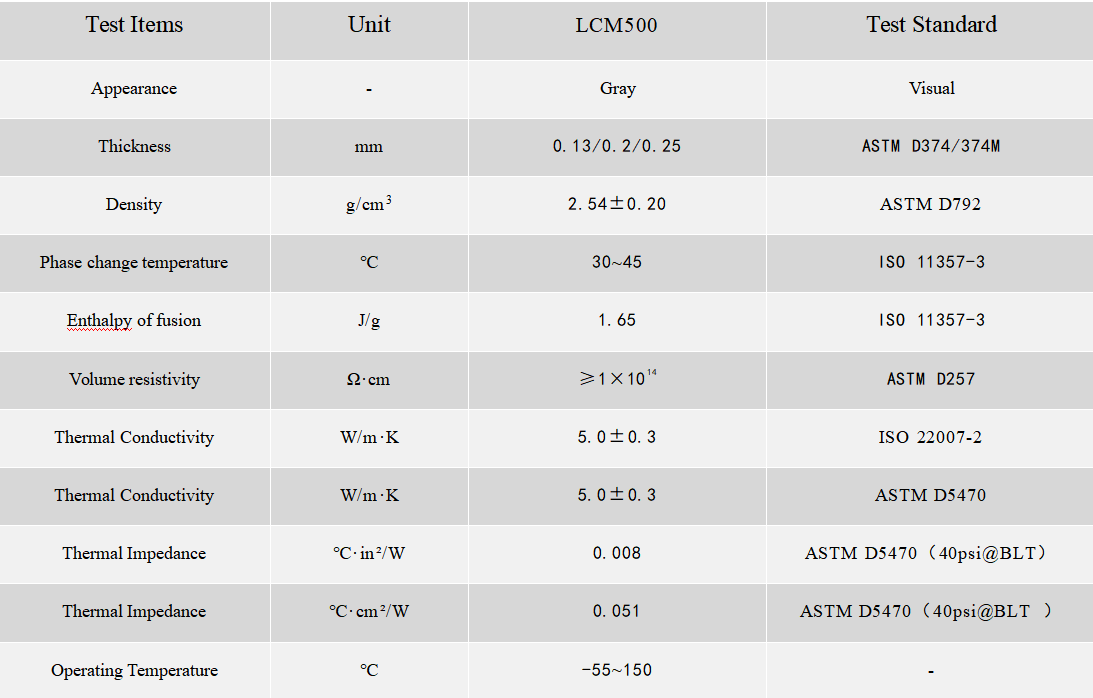
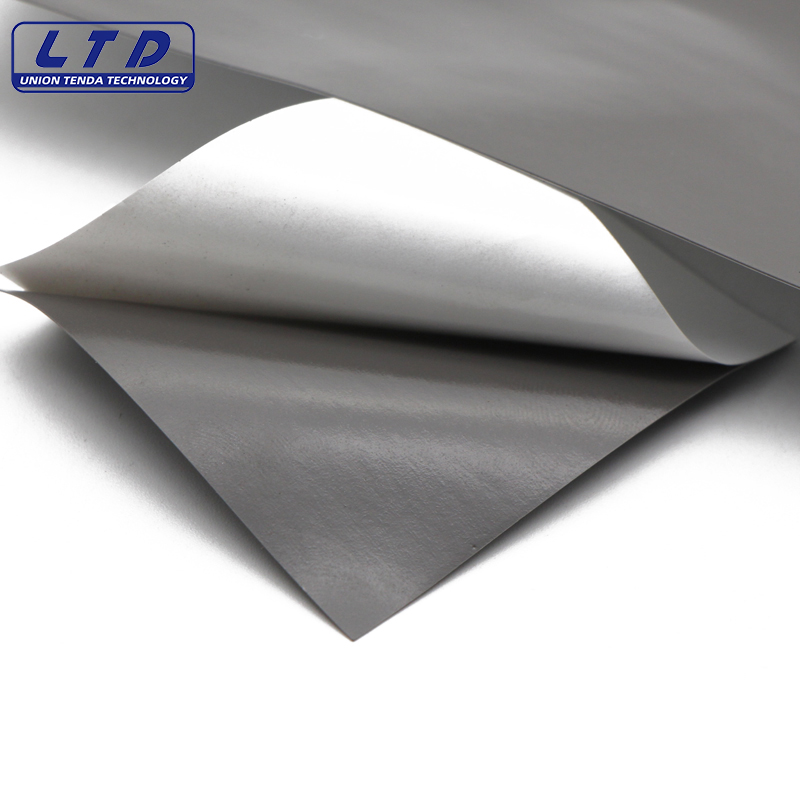
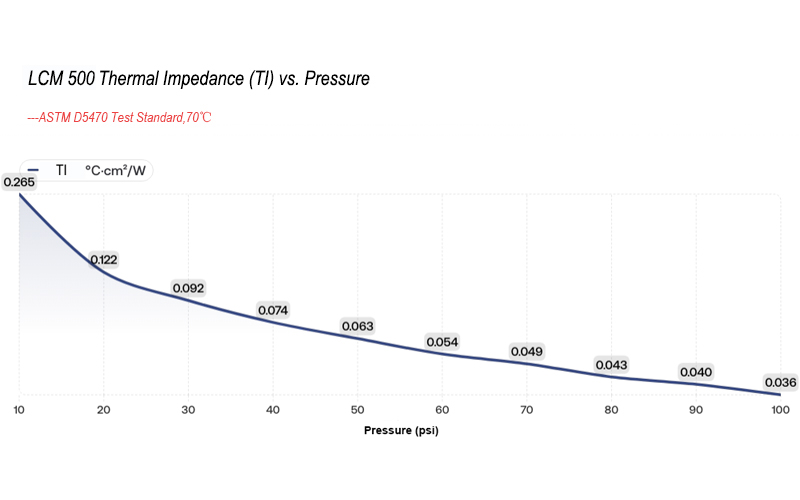
LCM500 is a non-electrically insulating phase change thermal pad designed for heat transfer between electronic components and heat sinks. It combines 5.0 ± 0.3 W/m·K thermal conductivity with a low thermal impedance of 0.008°C·in²/W, measured at 70°C and 40 psi.
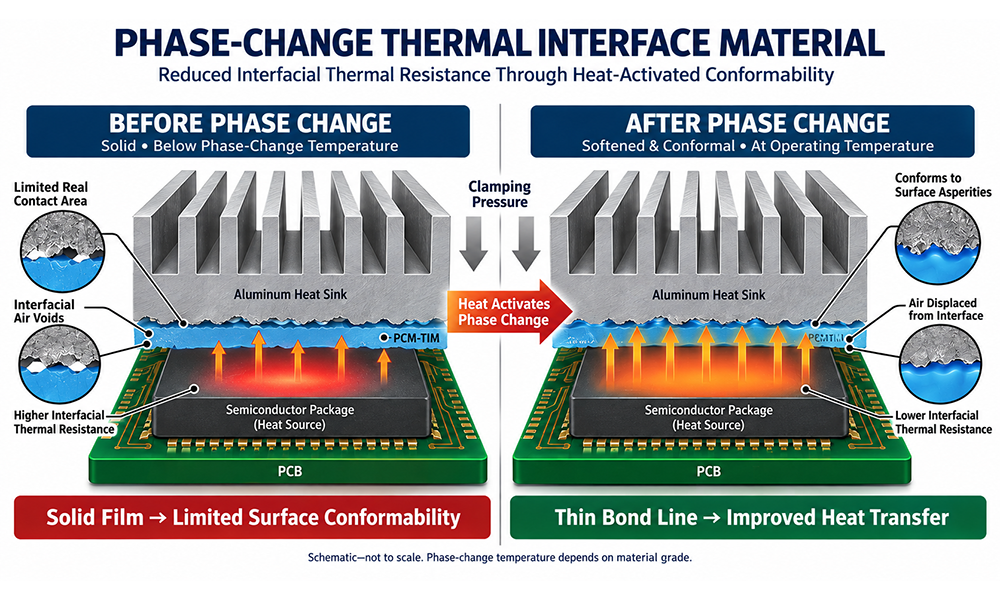
Solid at room temperature for convenient handling and installation, LCM500 transitions to a flowable state at 45°C. The material wets the mating surfaces and fills microscopic irregularities, helping reduce trapped air and interfacial thermal resistance.
With three thickness options and an operating temperature range of −55°C to +150°C, this phase change thermal interface material supports a variety of electronic thermal management applications.
|
Test Items |
Unit |
LCM500 |
Test Standard |
|
Appearance |
- |
Gray |
Visual |
|
Thickness |
mm |
0.13/0.2/0.25 |
ASTM D374/374M |
|
Density |
g/cm3 |
2.54±0.20 |
ASTM D792 |
|
Phase change temperature |
℃ |
30~45 |
ISO 11357-3 |
|
Enthalpy of fusion |
J/g |
1.65 |
ISO 11357-3 |
|
Volume resistivity |
Ω·cm |
≥1×10¹⁴ |
ASTM D257 |
|
Thermal Conductivity |
W/m·K |
5.0±0.3 |
ISO 22007-2 |
|
Thermal Conductivity |
W/m·K |
5.0±0.3 |
ASTM D5470 |
|
Thermal Impedance |
℃·in²/W |
0.008 |
ASTM D5470(40psi@BLT) |
|
Thermal Impedance |
℃·cm²/W |
0.051 |
ASTM D5470(40psi@BLT ) |
|
Operating Temperature |
℃ |
-55~150 |
- |
 Features and Benefits
A thermal conductivity of 5.0 ± 0.3 W/m·K supports heat transfer from heat-generating components to their cooling assemblies.
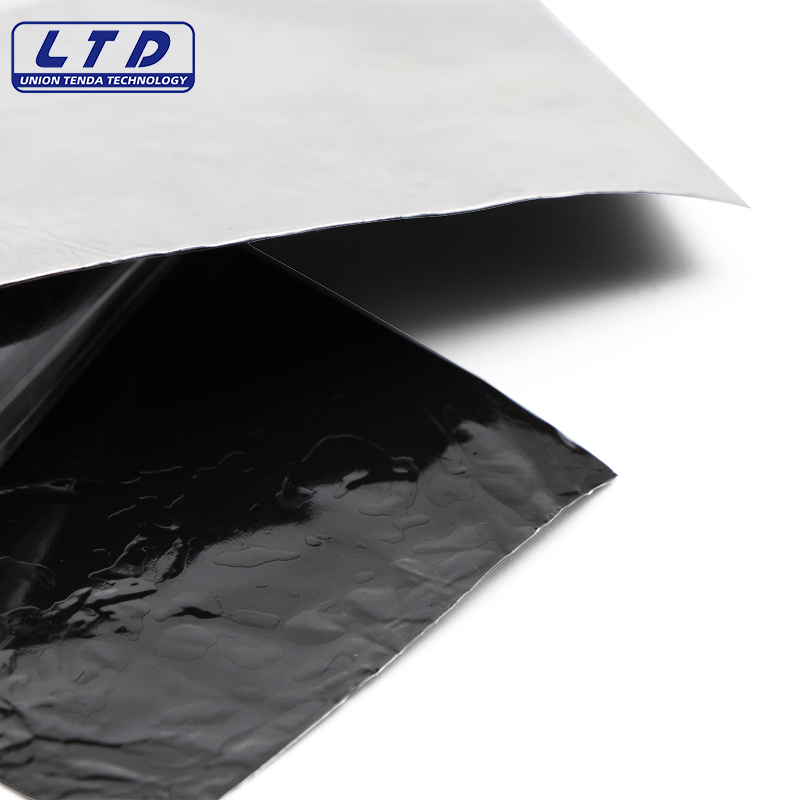
The pad remains solid at room temperature for easy positioning. At its phase transition temperature, it becomes flowable and conforms to microscopic surface irregularities.
The material wets the contact surfaces and fills microscopic voids, helping improve thermal contact and reduce air pockets at the interface.
LCM500 is designed to maintain stable thermal performance in applications requiring high reliability, without silicone oil bleeding.
Available in 0.13 mm, 0.20 mm and 0.25 mm thicknesses to accommodate different thermal interface designs.
Microscopic surface irregularities can leave air pockets between electronic components and heat sinks. These air pockets interrupt thermal contact and increase resistance to heat flow.
LCM500 is installed as a solid pad. When the interface reaches 45°C, the material transitions to a flowable state and wets the mating surfaces. This action helps fill microscopic voids, improves surface contact and reduces interfacial thermal resistance.
This combination of thermal conductivity and low thermal impedance makes LCM500 suitable for applications where efficient heat transfer through a thin thermal interface is required.
IC, CPU and GPU cooling: Thermal interfaces between heat-generating processors or integrated circuits and heat sinks.
Power electronics: Thermal management of power modules and power semiconductors.
Automotive electronics: Heat transfer in battery management systems (BMS), engine control units (ECU) and related electronic assemblies.
Networking and telecommunications: Thermal interfaces in routers and base station equipment.
LED lighting: Heat transfer between LED components and heat sinks.
Application consideration: LCM500 does not provide electrical insulation. Use it in assemblies where electrical isolation is not required from the thermal interface material.
LCM500 has a phase change temperature of 45°C. At this temperature, it transitions from a solid pad to a flowable material that wets the contact surfaces.
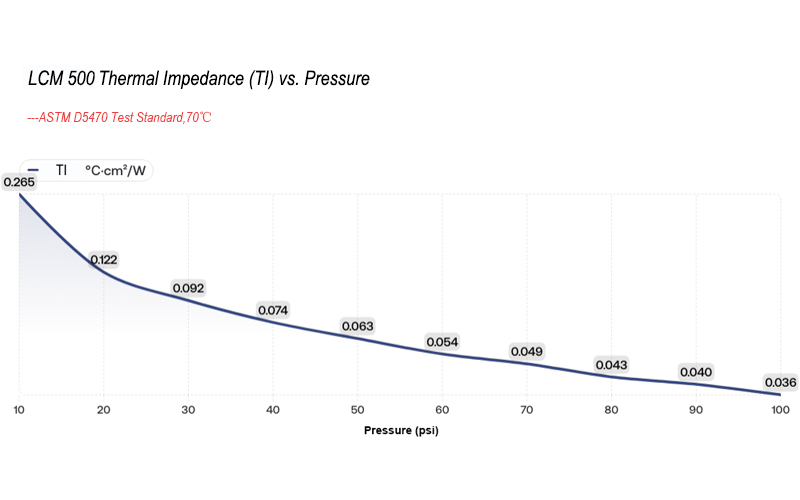
Its specified thermal impedance is 0.008°C·in²/W (0.051°C·cm²/W), measured at 70°C and 40 psi. These test conditions should be considered when comparing thermal interface materials.
No. LCM500 is non-electrically insulating and should not be relied on to provide electrical isolation between components and heat sinks.
LCM500 is available in 0.13 mm, 0.20 mm and 0.25 mm thicknesses.
LCM500 has a specified operating temperature range of −55°C to +150°C.

|
Test Items |
Unit |
LCM500 |
Test Standard |
|
Appearance |
- |
Gray |
Visual |
|
Thickness |
mm |
0.13/0.2/0.25 |
ASTM D374/374M |
|
Density |
g/cm3 |
2.54±0.20 |
ASTM D792 |
|
Phase change temperature |
℃ |
30~45 |
ISO 11357-3 |
|
Enthalpy of fusion |
J/g |
1.65 |
ISO 11357-3 |
|
Volume resistivity |
Ω·cm |
≥1×10¹⁴ |
ASTM D257 |
|
Thermal Conductivity |
W/m·K |
5.0±0.3 |
ISO 22007-2 |
|
Thermal Conductivity |
W/m·K |
5.0±0.3 |
ASTM D5470 |
|
Thermal Impedance |
℃·in²/W |
0.008 |
ASTM D5470(40psi@BLT) |
|
Thermal Impedance |
℃·cm²/W |
0.051 |
ASTM D5470(40psi@BLT ) |
|
Operating Temperature |
℃ |
-55~150 |
- |
LCM500 delivers a thermal impedance of 0.008°C·in²/W (0.051°C·cm²/W) under the specified test conditions of 70°C and 40 psi, supporting efficient heat transfer across the component-to-heat-sink interface.
A thermal conductivity of 5.0 ± 0.3 W/m·K supports heat transfer from heat-generating components to their cooling assemblies.
The pad remains solid at room temperature for easy positioning. At its phase transition temperature, it becomes flowable and conforms to microscopic surface irregularities.
The material wets the contact surfaces and fills microscopic voids, helping improve thermal contact and reduce air pockets at the interface.
LCM500 is designed to maintain stable thermal performance in applications requiring high reliability, without silicone oil bleeding.
Available in 0.13 mm, 0.20 mm and 0.25 mm thicknesses to accommodate different thermal interface designs.

Tel:+86-13691979380
+86-19065180554
E-mail:elvinlen@szutd.com
Carly@szutd.com
Address:8th Floor, Tower B, Lechuanghui Building, No. 1211 Guanguang Road, Longhua District, Shenzhen City, Guangdong Province


 Send Request
 Whatsapp